Rock stars as writers. As though acting and politics weren't enough.
The sidewalk ends...at the Playboy Mansion? Shel Silverstein exposed!
Visiting Elvis' library and tips to curating an Elvis themed library of your own.
Is manga the new hip hop? Police are harassing retailers like it was the good ol' NWA days. (via: thecomicsreporter.com)
And finally, Al Gore speaks about his book, An Assault On Reason, on BookTV.
Friday, June 15, 2007
Thursday, June 14, 2007
Author Du Jour: Annie Dillard
To honor the recent release of Annie Dillard's new novel, The Maytrees, we are dedicating today's posts to a variety of web-culled odds and ends relating to the author.
 The Basics:
Enjoy Wikipedia's brief bio of Annie Dillard, or head on over to the author's own website for her version of events. (Scroll down the main page of Dillard's website for a witty description of how and why she came to start it in the first place.)
The New Book:
As a part of their summer reading series, NPR has an audio clip of Dillard reading from The Maytrees, as well as a written excerpt.
Also of interest are a few reviews. USA Today, The Seattle Times, Miami Herald, New York Observer.
Two Interviews With The Author:
Lunch with Annie Dillard (1982 Malcolm Lawrence)
A brief interview where the author advises young writers to 'imitate, citing personal examples of the French symbolist poets, Old Testament poetry (Song of Solomon, Isaiah) and Wallace Stevens as original models for her poetry.'
She also recommends journalism classes to creative writing courses, saying, "Journalism teaches you to think of the reader. The trouble with people who major in creative writing is they often think the point of writing is to impress people, instead of to appeal to people. (For creative writing majors) the ideal courses to take are journalism and literature. I don’t think creative writing is such a great think to take, period, because you learn better how to take a text apart and put it back together from a literature course. And from a journalism course you learn how to appeal to the reader and organize your material. I’m hard put to say what you learn from a creative writing course. The people who major in English seem to have a really good understanding of how texts work. I wish I had more journalism majors in my classes, because I teach them just what they want to know."
Ideas Are Tough; Irony Is Easy (1996 Grace Suh)
Here Dillard lists her favorite authors, describes the havoc she wrecked on her body writing her first novel, and offers this advice to writers: "You have enough experience by the time you're five years old. What you need is the library. What you have to learn is the best of what is being thought and said. If you had a choice between spending a summer in Nepal and spending a summer in the library, go to the library."
An Essay on the Author:
The Ecolotheology of Annie Dillard: A Study in Ambivalence (1984 Pamela A. Smith)
Despite the fact that Dillard has said, "If I wanted to make a theological statement I would have hired a skywriter," the essayist holds a magnifying glass up to the writer's minutiae-filled work, attempting to 'find God in the details,' as they say.
 The Basics:
Enjoy Wikipedia's brief bio of Annie Dillard, or head on over to the author's own website for her version of events. (Scroll down the main page of Dillard's website for a witty description of how and why she came to start it in the first place.)
The New Book:
As a part of their summer reading series, NPR has an audio clip of Dillard reading from The Maytrees, as well as a written excerpt.
Also of interest are a few reviews. USA Today, The Seattle Times, Miami Herald, New York Observer.
Two Interviews With The Author:
Lunch with Annie Dillard (1982 Malcolm Lawrence)
A brief interview where the author advises young writers to 'imitate, citing personal examples of the French symbolist poets, Old Testament poetry (Song of Solomon, Isaiah) and Wallace Stevens as original models for her poetry.'
She also recommends journalism classes to creative writing courses, saying, "Journalism teaches you to think of the reader. The trouble with people who major in creative writing is they often think the point of writing is to impress people, instead of to appeal to people. (For creative writing majors) the ideal courses to take are journalism and literature. I don’t think creative writing is such a great think to take, period, because you learn better how to take a text apart and put it back together from a literature course. And from a journalism course you learn how to appeal to the
 reader and organize your material. I’m hard put to say what you learn from a creative writing course. The people who major in English seem to have a really good understanding of how texts work. I wish I had more journalism majors in my classes, because I teach them just what they want to know."
Ideas Are Tough; Irony Is Easy (1996 Grace Suh)
Here Dillard lists her favorite authors, describes the havoc she wrecked on her body writing her first novel, and offers this advice to writers: "You have enough experience by the time you're five years old. What you need is the library. What you have to learn is the best of what is being thought and said. If you had a choice between spending a summer in Nepal and spending a summer in the library, go to the library."
An Essay on the Author:
The Ecolotheology of Annie Dillard: A Study in Ambivalence (1984 Pamela A. Smith)
Despite the fact that Dillard has said, "If I wanted to make a theological statement I would have hired a skywriter," the essayist holds a magnifying glass up to the writer's minutiae-filled work, attempting to 'find God in the details,' as they say.
Wednesday, June 13, 2007
Tank Girl Would've Loved These
 Tank Girl and Gorillaz co-creator Jamie Hewlett has done the artwork for an exceptionally over-priced line of vibrators. One 'massage device' will set you back $250, while the set of six will cost you $1,650. While I find these cheeky and alluring, I can't help but wish that Hewlett would one day get back to drawing comics again. His cartooning is amazing, and deserves to be seen and not just felt.
To order, visit the Jimmyjane website.
(via: Pitchfork Media)
This Guy Gives New Meaning To The Term 'Televangelism'
 In honor of the last episode of HBO's hit series, The Sopranos,
The Kindlings.com is offering myspace mobsters everywhere an encore presentation of their podcast interview with Chris Seay, author of The Gospel According To Tony Soprano. Seay, the pastor of a progressive Christian community in Houston, Texas, wrote the book to 'explore the many reasons why (The Sopranos) has connected so deeply with American culture' and to 'expose the mysteries of faith, family, life, and God that permeate the show.'
Wow. Can you imagine what this guy could do with Davey & Goliath?
Inappropriate Flair
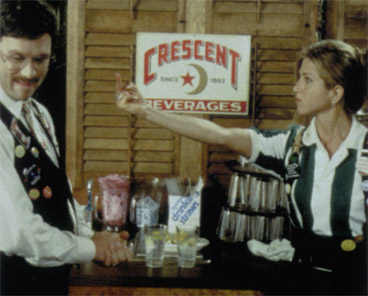 Big Bad Book Blog offers three rules to remember regarding superfluous stylistic flourishes for the aspiring author.
1. Less is more. Like loud fabrics, loud literary devices are hard to mix and match. If you’re going to narrate in stream-of-consciousness, do not also use screenplay-style stage directions and scene breaks. Pick the device that means the most to you. Once you’ve chosen your gimmick, don’t overdo it. Think of that guy you saw last weekend wearing all hot pink plaid. Did you say, “Wow, I admire his consistency to his theme”?
2. Make sure someone gets it. Kurt Vonnegut recommended writing with an audience of one in mind. Whoever you’re writing for, test it out. If your audience doesn’t like your device, you may want to consider toning it down. Even if you’re not thinking of a specific person as you compose, a suitably sympathetic, unbiased reader ought to be able to get through the device without trouble. I’m thinking your editor here.
3. Most important, make sure it’s crucial and authentic to the work, not just something you’re doing to show off. Christopher Bachelder’s Bear v. Shark uses stream-of-consciousness narration with two-page chapters and commercial breaks as its main style—a highly disruptive format. But the book is a satire about a near future in which television screens have taken over all four walls of the room and no longer turn off, where advertising invades our thoughts and the attention span is a thing of the past. The method is the message—so Bachelder’s outré style doesn’t distract from his point. (Also, the book is short—the author doesn’t expect us to get through three hundred pages of this bizarre prose.) If your device isn’t integral to your work, you’re probably better off without it.
To read the whole kit-n-kaboodle, click here.Tuesday, June 12, 2007
Generically Titled Collection Of Randomly Assorted Links
It took seven books, but they've finally found a negative aspect to the Harry Potter phenomenon. Psst, I've got a second one: adults who read one children's book every two years and then consider themselves 'readers.' (via Reuters)
Stephen King cheats on Entertainment Weekly with a flashier periodical. Do we tell EW, or just keep our noses out of it? (via AP)
Baby Got Books reads Dostoyevsky's Crime and Punishment in 241 e-mail snippets via the DayLit public domain literature service. He complains quite a bit about the experience, but is that because of the current limitations of e-books, or it the simply the cranky after-effects of reading depressing Russian literature?
Is Salma Hayek the flesh and blood incarnation of Gilbert Hernandez' Palomar characters? As a randy child, I confess to having enjoyed both equally. (via Bookslut)


Stephen King cheats on Entertainment Weekly with a flashier periodical. Do we tell EW, or just keep our noses out of it? (via AP)
Baby Got Books reads Dostoyevsky's Crime and Punishment in 241 e-mail snippets via the DayLit public domain literature service. He complains quite a bit about the experience, but is that because of the current limitations of e-books, or it the simply the cranky after-effects of reading depressing Russian literature?
Is Salma Hayek the flesh and blood incarnation of Gilbert Hernandez' Palomar characters? As a randy child, I confess to having enjoyed both equally. (via Bookslut)


Monday, June 11, 2007
Boys Have a Bookmark, Girls Have A Creased Binding
 The publishing industry continues its confused quest to attract tween & teen readers. This year's hot, new, x-treme marketing trend? Targeting readers according to the stereotypical and often inaccurate 'needs' of their gender. As one would imagine, the disembodied brains in the boardrooms handle this task as awkwardly as your parents did their bedside 'birds and the bees' speech.
via Gamer's Circle: Marketing comics to girls
via Los Angeles Times: Hooking the reluctant boy reader