 Pimp My Bookcart is a contest open to bookstores everywhere. The rules are simple. Decorate your store's bookcart in a manner befitting Superfly's six-tres, take a couple of pictures (a nice, professional Sears portrait with the woodland backdrop couldn't hurt) and send 'em on in to the mackadocious folks at unshelved.com. First prize is a Smith System Book Truck with Dividers -- retail value $314 -- and a $250 gift certificate to the Unshelved Store. Second prize is a Highsmith Double-sided Book Truck -- retail value $223 -- and a $50 gift certificate. Runners-up get $50 gift certificates and the sad realization they are not true pimps. Baaaallin'!
Friday, June 29, 2007
Bookstizzore Contizzest
Pimp My Bookcart is a contest open to bookstores everywhere. The rules are simple. Decorate your store's bookcart in a manner befitting Superfly's six-tres, take a couple of pictures (a nice, professional Sears portrait with the woodland backdrop couldn't hurt) and send 'em on in to the mackadocious folks at unshelved.com. First prize is a Smith System Book Truck with Dividers -- retail value $314 -- and a $250 gift certificate to the Unshelved Store. Second prize is a Highsmith Double-sided Book Truck -- retail value $223 -- and a $50 gift certificate. Runners-up get $50 gift certificates and the sad realization they are not true pimps. Baaaallin'!
Pretty Soon Godzilla Is Not Gonna Have Any Bookstores Left To Stomp On
 From Wired.com: "Chaco types furiously on her cell phone keypad, stopping only to take an occasional puff of her Seven Stars menthol cigarette. But she's not sending a text message. She's writing a novel.
Chaco is becoming one of the most popular mobile phone novelists in Japan. We don't know much about her -- except that she's a twenty-something Pisces from Osaka -- but we do know that she can spit out books faster than Danielle Steel. In the last 14 months, she wrote five novels, including her best seller, What the Angel Gave Me, which has sold more than 1 million copies to date.
A mobile phone novel typically contains between 200 and 500 pages, with each page containing about 500 Japanese characters. The novels are read on a cell phone screen page by page, the way one would surf the web, and are downloadable for around $10 each. The first mobile phone novel was written six years ago by fiction writer Yoshi, but the trend picked up in the last couple years when high-school girls with no previous publishing experience started posting stories they wrote on community portals for others to download and read on their cell phones.
Next summer, the company will debut software that allows mobile phone novelists to integrate sounds and images into their story lines. Adding visuals and vibrations to romance novels' steamy sex scenes could bring the genre an even wider audience."
They Better Not Touch The Size Of Thor's Hammer!

 Via: Comic Book Resources: The world of mainstream comics has taken its first steps towards acknowledging the existence of a female readership. DC Comics' Justice League of America #10 made internet headlines today when it was revealed that Power Girl's breast size had been reduced from the ridiculous to the merely unbelievable. This may not seem like much to most of you, but it's the comic book equivalent of that magic moment when Al Jolson first realized, 'Hey, maybe performing in blackface is offensive to some people.'
Thursday, June 28, 2007
Hip Hop Lit
When I first started listening to rap music in the late 80's/early 9o's, it seemed like every MC had a favorite book or two that they would name drop incessantly in songs and interviews. On the East coast, rappers were pushing The Autobiography of Malcolm X and pamphlets detailing the teachings of Brother Clarence 13X. Out West, Eldridge Cleaver's prison memoir, Soul On Ice, was the undisputed book of choice. It was a time when even so-called 'thugs' boasted of their continuing self-education, and artists with thoughtful, literary lyrics were often those with the highest sales. KRS-ONE spoke frequently of the period of his life spent homeless, and how much of that time was passed holed up in various New York libraries, reading voraciously. Public Enemy brought a 'minister of information' and a 'media assassin' along with them on tour, and stressed the need to study not only the writings of the politically and socially conscious, but also the works of the less-enlightened opposition. (It was through P.E. frontman, Chuck D, that I first heard mention of Willie Lynch's disturbing-as-it-sounds how-to treatise, Making Of A Slave, and you can just imagine the looks of disgust a fourteen year old White boy with a shaved head garnered while ordering this book at the local bookstore). A few of the other groups stressing the importance of reading in regards to self-empowerment were Brand Nubian, The Poor Righteous Teachers, The Wu-Tang Clan, Nas and the X-Clan (writer Sonny Carson's son, Lumumba a.k.a. Professor X, was a founding member).
My how times have changed. These days, you're more likely to hear a shout-out for Phil Jackson's autobiography than Malcolm X's, and starting a clothing line has long since replaced the dream of spearheading a revolution. That's not to say that there aren't a few artists still stressing brains over ballin'. Mos Def, Talib Kweli, Dead Prez and Immortal Technique spring immediately to mind. What's sad is that these artists are now viewed as 'underground' or 'alternative.' The hip hop mainstream, by and large, has become as shallow and tepid as its rock'n'roll counterpart. But like Coach Jackson says, things move in cycles. There's still a slight chance that politics and poetry will return to mainstream rap. Until then, we can enjoy the current crop of books being published by writers who came of age during the early days of hip hop, writers who grew up believing that in order to express oneself to the fullest, they must also expose themselves to the widest variety of influences -- not just in music, but also in literature. These writers are a part of the re-emerging hip hop intelligentsia, and are managing to achieve mainstream success without dumbing down their delivery. Listed below are a few of their books. I highly recommend them all.
 Can't Stop Won't Stop: A History of the Hip Hop Generation by Jeff Chang
From the book's website: Based on original interviews with DJs, b-boys, rappers, graffiti writers, activists, and gang members, with unforgettable portraits of many of hip-hop's forebears, founders, and mavericks, including DJ Kool Herc, Afrika Bambaataa, Chuck D, and Ice Cube, Can't Stop Won't Stop chronicles the events, the ideas, the music, and the art that marked the hip-hop generation's rise from the ashes of the 60s into the new millennium.
Bomb the Suburbs by William Upski Wimsatt
Written more like a collection of fanzine entries than a typical piece of non-fiction, Wimsatt covers topics as varied as train hopping, graffiti, rapping, breakdancing, train hopping and grassroots political activism -- all from the vantage point of someone who was there, actually participating in it before they ever thought of writing a book about it.
 Ego Trip's Book Of Rap Lists by Sacha Jenkins, Elliott Wilson, Chairman Mao, Gabriel Alvarez & Brent Rollins
From E.T.: If the editors of Mad were hip-hop heads, they might produce a book as funny, irreverent, and indispensable as this one. It's just as well that they're not, since the obsessives at rap fanzine ego trip have already assembled what may be the most readable, humorous, and enjoyable tome about rap music and culture extant. Within these pages is a wealth of fascinating trivia and arcane knowledge. Several hundred howl-inducing entries -- including ''# of Times the 'N' Word Appears on N.W.A's Albums,'' ''8 Songs About Body Odor,'' and ''Rap Artists Who've Survived Shootings'' -- constitute a funky fresh and decidedly def history lesson. One proviso: If there are other rap fans living with you, you may want to keep this ultimate bathroom book in the living room.
Unbelievable: Life, Death & Afterlife of The Notorious B.I.G. by Cheo Hodari Coker
Coker conducted quite a number of interviews to flesh out this detailed and surprisingly even-handed biography of the late, great 'rap Alfred Hitchcock.' In an interview with the Stanford Daily, Coker says, "B.I.G. was the one person, where through his life you could explore the history of hip-hop. When you look at his art, its more than just a gangsta rap record, it is about Reagan-omics and drug use in the ’80s, and how that affected the content of hip-hop. I wanted to show who it is he was, but not shy away from the Biggie who pulled guns, smoked weed and had more girls than any man should. When he got big, he was not only able to have music change his life, he brought in the people from the corner and showed them that instead of risking your life for $20,000, I can get you $20,000 a show.”
 The Wu-Tang Manual: Enter the 36 Chambers, Volume One by The RZA
Designed to look like a school text book, it was written with a similar goal: to educate like one. The Wu Manual not only gives the history of the Wu-Tang Clan's members, the group's formation and their brief domination of rap, it also dissects their work and highlights their wide variety of influences. The RZA discusses everything from Eastern religions and martial arts to vegetarian diets and Times Square in the early 80's. This is the sort of book that ends up costing you a lot of money in the long-run. Not because of its cover price, but because of all of the movies, music and books that it mentions that you will be curious to track down and experience for yourself.
Queens Reigns Supreme: Fat Cat, 50 Cent, And The Rise Of The Hip-Hop Hustler
by Ethan Brown
From The Onion AV Club: Ethan Brown's compulsively readable new page-turner Queens Reigns Supreme explores the ways in which the dope game and the rap game have inspired each other in Queens, documenting how the crack kingpins of the '80s gave way to the rap superstars and moguls of the '90s and today...Many of the kingpins Brown documents embody a compelling, ultimately fatal combination of street savvy and stupidity, like the crime boss who was smart enough to launder his drug money through seemingly legitimate businesses, but shortsighted enough to name those fronts, and himself, after Al Pacino's iconic Scarface gangster. Queens Reigns Supreme is full of juicy anecdotes, telling details, and larger-than-life characters, like the boss who had his car custom-made to dispense oil slicks and clouds of smoke, having seemingly gleaned the idea from a few too many lazy afternoons at the arcade playing Spy Hunter.
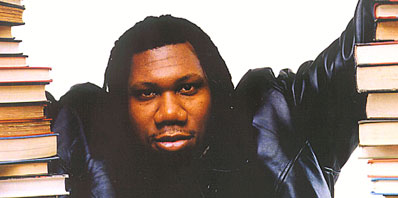 the highest sales. KRS-ONE spoke frequently of the period of his life spent homeless, and how much of that time was passed holed up in various New York libraries, reading voraciously. Public Enemy brought a 'minister of information' and a 'media assassin' along with them on tour, and stressed the need to study not only the writings of the politically and socially conscious, but also the works of the less-enlightened opposition. (It was through P.E. frontman, Chuck D, that I first heard mention of Willie Lynch's disturbing-as-it-sounds how-to treatise, Making Of A Slave, and you can just imagine the looks of disgust a fourteen year old White boy with a shaved head garnered while ordering this book at the local bookstore). A few of the other groups stressing the importance of reading in regards to self-empowerment were Brand Nubian, The Poor Righteous Teachers, The Wu-Tang Clan, Nas and the X-Clan (writer Sonny Carson's son, Lumumba a.k.a. Professor X, was a founding member).
My how times have changed. These days, you're more likely to hear a shout-out for Phil Jackson's autobiography than Malcolm X's, and starting a clothing line has long since replaced the dream of spearheading a revolution. That's not to say that there aren't a few artists still stressing brains over ballin'. Mos Def, Talib Kweli, Dead Prez and Immortal
 Technique spring immediately to mind. What's sad is that these artists are now viewed as 'underground' or 'alternative.' The hip hop mainstream, by and large, has become as shallow and tepid as its rock'n'roll counterpart. But like Coach Jackson says, things move in cycles. There's still a slight chance that politics and poetry will return to mainstream rap. Until then, we can enjoy the current crop of books being published by writers who came of age during the early days of hip hop, writers who grew up believing that in order to express oneself to the fullest, they must also expose themselves to the widest variety of influences -- not just in music, but also in literature. These writers are a part of the re-emerging hip hop intelligentsia, and are managing to achieve mainstream success without dumbing down their delivery. Listed below are a few of their books. I highly recommend them all.
 Can't Stop Won't Stop: A History of the Hip Hop Generation by Jeff Chang
From the book's website: Based on original interviews with DJs, b-boys, rappers, graffiti writers, activists, and gang members, with unforgettable portraits of many of hip-hop's forebears, founders, and mavericks, including DJ Kool Herc, Afrika Bambaataa, Chuck D, and Ice Cube, Can't Stop Won't Stop chronicles the events, the ideas, the music, and the art that marked the hip-hop generation's rise from the ashes of the 60s into the new millennium.
Bomb the Suburbs by William Upski Wimsatt
Written more like a collection of fanzine entries than a typical piece of non-fiction, Wimsatt covers topics as varied as train hopping, graffiti, rapping, breakdancing, train hopping and grassroots political activism -- all from the vantage point of someone who was there, actually participating in it before they ever thought of writing a book about it.
Ego Trip's Book Of Rap Lists by Sacha Jenkins, Elliott Wilson, Chairman Mao, Gabriel Alvarez & Brent RollinsFrom E.T.: If the editors of Mad were hip-hop heads, they might produce a book as funny, irreverent, and indispensable as this one. It's just as well that they're not, since the obsessives at rap fanzine ego trip have already assembled what may be the most readable, humorous, and enjoyable tome about rap music and culture extant. Within these pages is a wealth of fascinating trivia and arcane knowledge. Several hundred howl-inducing entries -- including ''# of Times the 'N' Word Appears on N.W.A's Albums,'' ''8 Songs About Body Odor,'' and ''Rap Artists Who've Survived Shootings'' -- constitute a funky fresh and decidedly def history lesson. One proviso: If there are other rap fans living with you, you may want to keep this ultimate bathroom book in the living room.
Unbelievable: Life, Death & Afterlife of The Notorious B.I.G. by Cheo Hodari Coker
Coker conducted quite a number of interviews to flesh out this detailed and surprisingly even-handed biography of the late, great 'rap Alfred Hitchcock.' In an interview with the Stanford Daily, Coker says, "B.I.G. was the one person, where through his life you could explore the history of hip-hop. When you look at his art, its more than just a gangsta rap record, it is about Reagan-omics and drug use in the ’80s, and how that affected the content of hip-hop. I wanted to show who it is he was, but not shy away from the Biggie who pulled guns, smoked weed and had more girls than any man should. When he got big, he was not only able to have music change his life, he brought in the people from the corner and showed them that instead of risking your life for $20,000, I can get you $20,000 a show.”
 The Wu-Tang Manual: Enter the 36 Chambers, Volume One by The RZA
Designed to look like a school text book, it was written with a similar goal: to educate like one. The Wu Manual not only gives the history of the Wu-Tang Clan's members, the group's formation and their brief domination of rap, it also dissects their work and highlights their wide variety of influences. The RZA discusses everything from Eastern religions and martial arts to vegetarian diets and Times Square in the early 80's. This is the sort of book that ends up costing you a lot of money in the long-run. Not because of its cover price, but because of all of the movies, music and books that it mentions that you will be curious to track down and experience for yourself.
Queens Reigns Supreme: Fat Cat, 50 Cent, And The Rise Of The Hip-Hop Hustler
by Ethan Brown
From The Onion AV Club: Ethan Brown's compulsively readable new page-turner Queens Reigns Supreme explores the ways in which the dope game and the rap game have inspired each other in Queens, documenting how the crack kingpins of the '80s gave way to the rap superstars and moguls of the '90s and today...Many of the kingpins Brown documents embody a compelling, ultimately fatal combination of street savvy and stupidity, like the crime boss who was smart enough to launder his drug money through seemingly legitimate businesses, but shortsighted enough to name those fronts, and himself, after Al Pacino's iconic Scarface gangster. Queens Reigns Supreme is full of juicy anecdotes, telling details, and larger-than-life characters, like the boss who had his car custom-made to dispense oil slicks and clouds of smoke, having seemingly gleaned the idea from a few too many lazy afternoons at the arcade playing Spy Hunter.
Wednesday, June 27, 2007
Generically Titled Collection of Randomly Assorted Links
David Foster Wallace fans wonder: Are these really his top ten novels?1 Will this flurry of online controversy leave Houghton Mifflin similarly second-guessing Wallace's picks for The Best American Essays2 of 2007?
The first image from the upcoming film adaptation of Maurice Sendak's Where The Wild Things Are has popped up on the internet via Mtv.com. The film is directed by Spike Jonze (Being John Malkovich, Adaptation) and adapted by Jonze and Dave Eggers (A Heartbreaking Work of Staggering Genius, What Is The What).

The Brontë sisters' childhood home nets a withering price -- £178,000. That's only £12,000 more than the historically insignificant house next door sold for last month, say the gossips at the Guardian UK.
Comics scribe Warren Ellis is set to release his first novel, Crooked Little Vein, next month. He discusses the transition with Newsarama.com and Publisher's Weekly.
Angsty, Fight Club-worshiping teens will have already punched their fists through their flatscreens before getting this far, but the rest of you can click here to see a video of Chuck Palahniuk on 'The Hour' with George Stroumboulopoulos. Among other things, Palahniuk reveals his trick to writing emotionally distraught characters realistically: hang out at hospital emergency rooms and steal people's ticks.
1. Without all of those footnotes, it's hard to know when D.F.W. is being serious or just joshing.
2. D.F.W. is co-editing this year's B.A.E. anthology.
The first image from the upcoming film adaptation of Maurice Sendak's Where The Wild Things Are has popped up on the internet via Mtv.com. The film is directed by Spike Jonze (Being John Malkovich, Adaptation) and adapted by Jonze and Dave Eggers (A Heartbreaking Work of Staggering Genius, What Is The What).

The Brontë sisters' childhood home nets a withering price -- £178,000. That's only £12,000 more than the historically insignificant house next door sold for last month, say the gossips at the Guardian UK.
Comics scribe Warren Ellis is set to release his first novel, Crooked Little Vein, next month. He discusses the transition with Newsarama.com and Publisher's Weekly.
Angsty, Fight Club-worshiping teens will have already punched their fists through their flatscreens before getting this far, but the rest of you can click here to see a video of Chuck Palahniuk on 'The Hour' with George Stroumboulopoulos. Among other things, Palahniuk reveals his trick to writing emotionally distraught characters realistically: hang out at hospital emergency rooms and steal people's ticks.
1. Without all of those footnotes, it's hard to know when D.F.W. is being serious or just joshing.
2. D.F.W. is co-editing this year's B.A.E. anthology.
Tuesday, June 26, 2007
Author du Jour: Brent Runyon
 The Inkwell Bookstore is dedicating all of today's links to Brent Runyon, author of the critically acclaimed autobiography The Burn Journals and the recently released novel Maybe. Reprinted without any care for copyright is a brief note from the author, found on his publisher's website:
"I don’t know if I would be a writer if I hadn’t, when I was fourteen years old, set myself on fire. I think I probably wouldn’t be.
I think doing that to myself — lighting myself on fire, burning away eighty-five percent of my body and then somehow living through it. I think doing that to myself took me out of my life as a teenager. It made me an observer, and much more introspective.
One of the first things I started doing — after I got well enough to go back to school — was start working on a novel. It wasn’t very good, of course, but it was good for me. It was supposed to be about a boy who’d made a terrible mistake when he was young — in the book he killed someone else - and then spent the rest of his life trying to undo that mistake.
It’s probably pretty obvious that I was writing about my own regrets, but at the time I thought I was making stuff up.
As I work on my writing now, all these years later, I’m still surprised at how deeply my writing is connected to the parts of myself I’m unwilling to confront. And when I write about those unspoken things, those embarrassments, those dark and terrible secrets, and put them on the page, I’m still surprised at how easy it is for other people to understand them.
That, for me, is the greatest thing about being a writer. Making those connections and relating to other people who’ve felt the same things I’ve felt."
Here is a one minute clip of Mr. Runyon introducing his autobiography as part of the 'Meet the Author' series. (Brent, I apologize in advance for the open-mouthed screen cap that is freeze-framed below. I assure you it is all the doing of those millionaire Google folks. If offended, please direct your lawyers their way.)
To read an excerpt from The Burn Journals, click here.
To peruse a few pages of Maybe, dab your cursor here.
Runyon is also known for his work in public radio. Below are links to two different clips he produced for NPR.
1. Lost and Found Sound: Loons
2. Shake Marilyn Monroe
Perhaps less well known, but no less worth knowing, is Runyon's secret life as a rock star. To hear his solo acoustic version of Public Enemy's 'Bring The Noise,' click here.


Monday, June 25, 2007
Magical Boys Dying Mystical Deaths Are A Part Of Everyday Life: Explaining Mortality To Your Soon-To-Be Grieving Child
 Word on the street is that Harry Potter is heading to heaven (or hell, depending upon your church's feelings regarding the damning qualities of practicing witchcraft and/or the use of the phrase "bloody hell"). This ill portent has normally sensible publications addressing predictably overly-protective parents' fears as to how they are supposed to deal with their child's possible reaction to a fictional character's death. Apparently, just saying 'It's only a book' and then trusting them to understand this is a violation of the parent-child contract (see below), and a sure fire way to inspire your young'un to writing reams of best selling misery lit in the years to come. Experts -- and those falsely claiming be experts -- now warn that just because your kid has read thousands of pages of fiction in the past couple of years is no reason to assume that they possess any real intelligence. No, it's the responsibility of parents everywhere to call their kids down off of their flying broomsticks and explain to them that the entire Harry Potter series was, in fact, fake. Why none of these moms and dads had thought to do this six books ago is beyond me. Maybe watching their kids run face first into cement pillars at the subway station was just too much fun.
Anyway, the British newspaper, The Telegraph, has called in Michael Brody, a leading American child psychologist with a doctorate in imaginary medicine and apparently no concern whatsoever for his reputation among his professional peers, to draw up a three-point plan "to help parents comfort their tearful children."
No, seriously, they actually did. Here it is, reprinted without permission in all of its bold print glory:
1) Do not think that they will be scarred for life. Many parents today think that their children cannot experience any anxiety without rushing in, so they do not get any practice dealing with it. Reading a book where there is a conflict and terror is not the worst thing in the world. And the thing about reading as opposed to visual images on television is that it gives children time to process it.
2) Use the experience as a teaching moment. For younger children, there are two big mysteries: where do babies come from, and what happens when people die? If there is a death in the book, it is up to the parents to have a discussion. That said, the book may not be appropriate for very young children.
3) Do not say, "It's just a book!" You do have to make it clear that this is a fictional character, but to a child Harry Potter is very real, so his or her feelings are going to be very real. In some ways parents are going to have to deal with this in the same way they would with the death of a family member or pet.
 Okay, so #1 sort of says what I was saying: that kids can handle it and that parents shouldn't worry themselves too much. (But wouldn't this negate the need for tips 2 & 3? My guess is that Dr. Brody is billing by the hour and feels it's only proper to give the newspaper their money's worth.) As for #2, I always figured that the particulars of sex and death oughta be broached in different conversations, but we're in the era of the Suicide Girls, so maybe I'm just old-fashioned. #3 seems stupid to me, though. Who's going to call in all of their extended relatives to help flush a book down the toilet? Wouldn't it be simpler for the Montessori schools just to take a day off of decoupage to address all of this? Besides segregating well-to-do children from their poorer peers and instilling in them an inappropriate sense of individual entitlement, isn't that the sort of touchy-feely programming that we're paying them for?
Now, I'm not gonna front. I'm no specialist in the loss of imaginary friends. But I've got a hell of a lot easier of explanation to offer your kids (who will, I'm sure, be wishing you were detailing the baby-making process to them instead). Tell 'em that when good people die, that they're not suffering. Tell them that so long as we remember them, that they're always with us, in our hearts. And then assure them that when fictional characters who have made their authors and publishers billions of dollars in royalties and merchandising rights are eventually written to death, it's a foregone conclusion that they will come back to visit us in prequels.
Original heads up: Movie City News
Photos by: Jill Greenberg