Friday, May 2, 2008
Book News, In Brief
(if a picture is worth a thousand words, consider this post three thousand words short)
Fans of Y: The Last Man and/or the heart warming antics of poop slinging monkey sidekicks will get a kick out of this news bit, via a Hyperion press release: Hyperion have pre-empted North American rights to KASEY TO THE RESCUE: How a Capuchin Monkey Saved a Family in Despair by Ellen Rogers. Hyperion President Ellen Archer announced the deal saying: "This remarkable story of a mother's love for her son and the irresistible monkey who transforms their lives will leave readers laughing through their tears. It is one of those rare books that celebrates what it means to be a family in both the best and the worst of times." Read that last part again. Whoever wrote that is either a sarcastic genius or a hyperbolic idiot. It's a thin line, innit?
Via The AP: Chick lit is on the rise in Nigeria's Muslim north, with predictably divided results. On the one hand, the female fans say that the books "help them navigate contemporary life and their titles are proliferating rapidly, pitting younger women against a predominantly male, conservative elite," while the fellas feel they're "pulp fiction that degrades Islamic and indigenous cultural mores." Paging Nora Ephron, Matthew McConaughey and that girl from Almost Famous: this sounds like a wacky rom-com in the making.
Reason #4356842 why I think Americans mostly suck, via Yahoo News: People in Argentina, Mexico, Egypt and China are more likely than those in the United States to say it is very important for the news media to be free from government control, a survey published on Thursday found. The survey of 20 countries by World Public Opinion.org at the University of Maryland, found strong support worldwide for a free press and opposition to government restrictions on access to the Internet. But in the United States, where residents believed the news media already had significant freedoms, many people did not support further protections for the press, the survey showed.
Via The AP: Chick lit is on the rise in Nigeria's Muslim north, with predictably divided results. On the one hand, the female fans say that the books "help them navigate contemporary life and their titles are proliferating rapidly, pitting younger women against a predominantly male, conservative elite," while the fellas feel they're "pulp fiction that degrades Islamic and indigenous cultural mores." Paging Nora Ephron, Matthew McConaughey and that girl from Almost Famous: this sounds like a wacky rom-com in the making.
Reason #4356842 why I think Americans mostly suck, via Yahoo News: People in Argentina, Mexico, Egypt and China are more likely than those in the United States to say it is very important for the news media to be free from government control, a survey published on Thursday found. The survey of 20 countries by World Public Opinion.org at the University of Maryland, found strong support worldwide for a free press and opposition to government restrictions on access to the Internet. But in the United States, where residents believed the news media already had significant freedoms, many people did not support further protections for the press, the survey showed.
Wednesday, April 30, 2008
Tuesday, April 29, 2008
A Quick Tip for Comics Fans
While scrolling through Journalista this morning, I came across this link:
[Review] Craig Fischer on Eddie Campbell’s seminal post-adolescent reverie, The King Canute Crowd. (Above: sequence from the book, ©2000 Eddie Campbell.)
 ...which proved to be an interesting, slightly academic look at one of my all-time favorite comics, but one written more for those familiar with the book than those who are not.
It also contained this paragraph and its embedded link :
There's plenty of literature about adolescent rebellion--do they still make high school kids read The Catcher in the Rye and A Separate Peace?--but it seems to me that the art dries up once the rebel disconnects from repressive structures like boarding schools and dysfunctional families. Once the rebel achieves a degree of freedom, his or her goal becomes existential and contemplative ("How will I live my life?") and questions like these don't lend themselves as easily to dramatic treatment as, say, conflicts between a priggish schoolmaster and a smartass student. There are authors, though, who make "How will I live my life?" a major theme of their work: Joyce explores how difficult it is to fly above the nets of "language, nationality, religion," for instance, and Kerouac's Dean Moriarty exemplifies the dangers inherent in the quest for freedom. (Warren Ellis has a sharp commentary on some of the connections between On the Road and Canute.)
Ellis' article takes a different approach to Fischer's. It's a review of sorts, disguised as memoir. While browsing around in a comic book shop, Ellis' friend hands him a copy of the collected Alec comics, and off Ellis goes, remembering his initial impressions of the book, as well as his feelings about it's updated form and content.
An excerpt:
 These are the stories of Eddie's life in the Southend area, drinking at the King Canute. Eddie is Alec McGarry. Danny Grey's real name is Bob Grey. It's autobiographical fiction with the names changed, which seems to allow Eddie an essential distance to do it right. And it skirts all the usual pitfalls of autobio fiction. It shows life being lived. This may have to be explained to mavens of American autobio comics. This is not the same as Chester Brown beating off, or Julie Doucet being pathetic, or the awful spectacle of Harvey Pekar just doing nothing worth looking at for years on end. And it's not the same as Dennis Eichhorn's autobio stuff, which was genuinely interesting and engaging but never really used the medium very well. This is one of the great instinctual masters of the medium taking everyday life and showing it being lived, showing people achieving and losing and changing and loving and hating, making the living of life glorious and riveting - life as we remember it when we look back on it.
This is the article you'll want to read if you've never read Alec: The King Canute Crowd. If'n you have read it, then this is the article that you should make your friends read in order to get them reading it as well.
Wow. Two great pieces about one great comic. What a wonderful way to spend a lunch break.
[Review] Craig Fischer on Eddie Campbell’s seminal post-adolescent reverie, The King Canute Crowd. (Above: sequence from the book, ©2000 Eddie Campbell.)
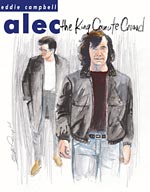 ...which proved to be an interesting, slightly academic look at one of my all-time favorite comics, but one written more for those familiar with the book than those who are not.
It also contained this paragraph and its embedded link :
There's plenty of literature about adolescent rebellion--do they still make high school kids read The Catcher in the Rye and A Separate Peace?--but it seems to me that the art dries up once the rebel disconnects from repressive structures like boarding schools and dysfunctional families. Once the rebel achieves a degree of freedom, his or her goal becomes existential and contemplative ("How will I live my life?") and questions like these don't lend themselves as easily to dramatic treatment as, say, conflicts between a priggish schoolmaster and a smartass student. There are authors, though, who make "How will I live my life?" a major theme of their work: Joyce explores how difficult it is to fly above the nets of "language, nationality, religion," for instance, and Kerouac's Dean Moriarty exemplifies the dangers inherent in the quest for freedom. (Warren Ellis has a sharp commentary on some of the connections between On the Road and Canute.)
Ellis' article takes a different approach to Fischer's. It's a review of sorts, disguised as memoir. While browsing around in a comic book shop, Ellis' friend hands him a copy of the collected Alec comics, and off Ellis goes, remembering his initial impressions of the book, as well as his feelings about it's updated form and content.
An excerpt:
 These are the stories of Eddie's life in the Southend area, drinking at the King Canute. Eddie is Alec McGarry. Danny Grey's real name is Bob Grey. It's autobiographical fiction with the names changed, which seems to allow Eddie an essential distance to do it right. And it skirts all the usual pitfalls of autobio fiction. It shows life being lived. This may have to be explained to mavens of American autobio comics. This is not the same as Chester Brown beating off, or Julie Doucet being pathetic, or the awful spectacle of Harvey Pekar just doing nothing worth looking at for years on end. And it's not the same as Dennis Eichhorn's autobio stuff, which was genuinely interesting and engaging but never really used the medium very well. This is one of the great instinctual masters of the medium taking everyday life and showing it being lived, showing people achieving and losing and changing and loving and hating, making the living of life glorious and riveting - life as we remember it when we look back on it.
This is the article you'll want to read if you've never read Alec: The King Canute Crowd. If'n you have read it, then this is the article that you should make your friends read in order to get them reading it as well.
Wow. Two great pieces about one great comic. What a wonderful way to spend a lunch break.
Book News, In Brief
 The pointless debate is over. Nabokov's son is going ahead with his plans to publish pop's unfinished book, despite pop's deathbed pleas to the contrary. According to Junior, Senior's ghost appeared before him and said, "You’re stuck in a right old mess. Just go ahead and publish." No, seriously -- this is what the jerk claims happened.
 I swear to God, those folks saying that the media is controlled by liberals aren't seeing the same press releases that I am. Via Reuters: Americans are among the world's most 'Bible-literate' people...the poll...also showed Americans were most willing to donate money to spread the message of the Bible. This follows last month's headline that the Bible is America's favorite book. Yeah, right. May lightning strike them down.
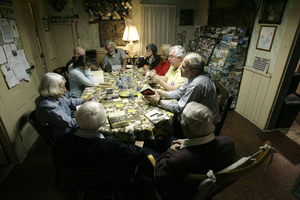 A St. Mary's, PA book club has just finished its 800th book -- after 48 years of regular meetings. These avid reading spring chickens find Cormac McCarthy to be the "most fascinating new writer that (they've) read in a long time," and once, when a book order was delayed, they held a meeting discussing an issue of MAD magazine. Truth be told, they sound better than most of the book clubs I've been to.
Monday, April 28, 2008
Book News, In Brief
 If less and less people are reading books every year, why are more and more people writing them? Rachel Donadio discusses.If comics publishers want better press for their books, why aren't they providing better PR? Laura Hudson critiques the phenomenon, then offers a handful of helpful tips.
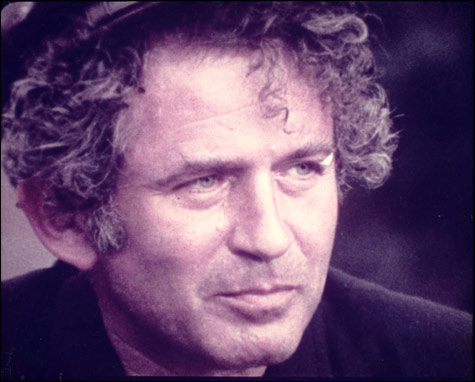 Norman Mailer’s former mistress has sold papers that include lengthy accounts of their sex life and hand-edited drafts of her writing to Harvard University, Mailer’s alma mater. Carole Mallory, an actress and writer, saved seven boxes of material she collected during Mailer’s weekly visits between 1983 to 1992, while Mailer was married to his sixth and last wife, Norris Church. "We’d have a writing lesson, we’d make love and then go to lunch in whatever order that would be, and I saved all the writing lessons," said Mallory, 66.
Seeing as how nothing ever became of Mallory's writing (despite her connections), I think it's safe to say that she was probably a better lover than a author. The fact that she sold the Mailer papers to Harvard (instead of simply donating them), leads me to believe that she's more of a gold-digger than a do-gooder.
 This year's Orwell Prize winner has been announced. The details, via The Guardian UK: Britain's most prestigious award for political writing, the Orwell book prize, has been won by Raja Shehadeh's Palestinian Walks, a victory further distinguished by such strong competition that the judges felt the need to extend this year's shortlist. The subtitle of Shehadeh's book is Notes on a Vanishing Landscape, and it describes how over 40 years the West Bank he loves has been steadily taken over by Israeli settlements, and how the destruction of a beloved landscape mirrors the damage to Palestinian identity. Judges praised its combination of lyrical nature writing with understated political passion.
 Bonus: To hear Raja Shehadeh discuss Palestinian Walks, click here.
The Collected Reviews of:
The Library At Night
 Christine Thomas reviews The Library At Night, a book sure to appeal to bookstore folk (as we're also obsessive collectors and catalogers). An excerpt: Alberto Manguel's new book is a vivaciously erudite justification for society's inexorable efforts to collect, order and store information. Inspired by the library he built in his French home, he explores the myriad levels on which a library functions and how readers interact with and in them.The book is divided into 15 categories, each chapter exploring the library in a different light -- as myth, survival, power, etc. Manguel revisits childhood bookshelves as well as libraries in ancient Egypt, Greece, Arab countries (including the legendary Library of Alexandria) and the personal book collections of Charles Dickens and Manguel's fellow Argentine Jorge Luis Borges (himself a librarian).
The Guardian UK also reviews TLAN, but focuses on a section of the book that will make most bookstore owners and employees cringe: Manguel is old, wise and sad enough to know that the future belongs to the users of the Kindle reading device and to oafish librarians who discard books as landfill after transferring their contents to disks or CD-Roms that may be illegible in a decade. He therefore likens his own library to the coffin of native earth that Dracula carries with him from Transylvania to London.
But wait, then it gets pro-pulp again: It's a good joke, but it's unjust. Milton said that a great book was 'the precious lifeblood of a master spirit': literally an infusion or transfusion of life, not a portable grave in which the undead quietly slumber. Reading, as Manguel knows, is 'a ritual of rebirth', which both invigorates the reader and awakens old books to new life. He shows what he means by describing his dreams of a fluid subliminal library, a place where the hero of Kafka's The Castle sails off in a quest for the Holy Grail on the whaling vessel from Melville's Moby Dick, then after a shipwreck lands on an island where, like Crusoe, he reconstructs civilisation by consulting the three bibles he has salvaged from the wreck. Books jump out of their jackets when Manguel opens them and dance in delight as they make contact with his ingenious, voluminous brain. He is not the keeper of a silent cemetery, but a master of bibliographical revels.
Still not convinced this book is worth picking up? Here are links to reviews in The Washington Post, The LATimes, and an excerpt of the book, care of Random House.