Brief backstory: While reading the following article this morning, I literally snarfed my coffee. I immediately wanted to respond to some of the more ludicrous statements made by the speakers quoted, but couldn't think of an even-handed way of doing so without basically reprinting the whole piece. Then it hit me: Why
not re-print the whole piece, inserting my opinions as I went along?
So's I did.
All
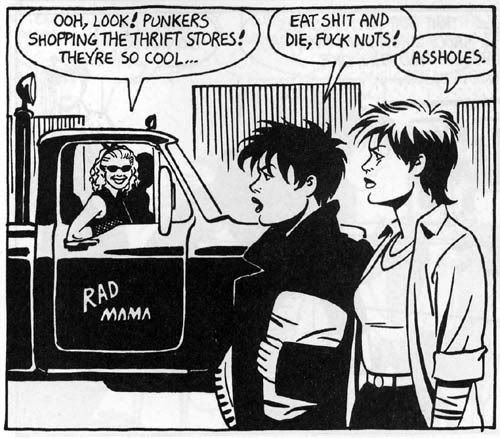
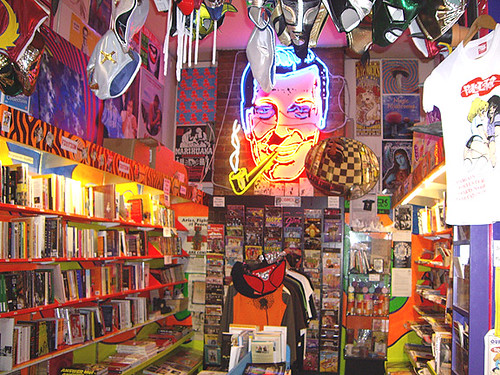
bold print is from the original article. All anorexic print and the accompanying illustrations are mine.
(Oh, and a special note to Brice Wallace, the author of the article:
Please don't sue me. I'm not criticizing you here. I'm only criticizing the folks you quoted.)Technology is a new chapter for booksellersBy Brice Wallace
Originally published in The Deseret News on Friday, Jan. 30, 2009
Chalk up booksellers as another industry group challenged by new technology, but they were encouraged on Friday to jump aboard the tech train rather than compete with it.A panel at the opening of the American Booksellers Association's winter get-together suggested that booksellers see technology — such as e-books — as an opportunity rather than a threat."We've all got to figure out how to use online to make our businesses work," Bob Miller, president and publisher of HarperStudio, part of HarperCollins Publishers, told a group of about 450 people in Salt Lake City.Nan Graham, editor-in-chief of Scribner, said booksellers need to "figure out" their "territorial role" in the e-book industry. Panelists suggested a few ways booksellers can do that, including serving as guides and experts for their customers."All you need to do is shout-outs every day for things you think are of value. You all have expertise as influencers that you have to make use of online," Miller said. "There is so much noise out in the marketplace and people are asking for direction — how to find the stuff that's worthwhile — and you guys do that," said Morgan Entrekin, president and publisher of Grove/Atlantic Inc. "You take ownership over your business, because you have a knowledge base of your local community. And I think that that's going to create great opportunity for you."Panelists said all independent booksellers need to blog as a way to capitalize on their expertise. One bookseller said a video blog propelled a local wine seller to online prominence, expert status and huge sales for his business. "When we say you should blog, we really mean that a 20-year-old on your staff should," Miller said, evoking laughter from the audience.Miller said such use of technology may not produce results quickly, but it also is not expensive. "It costs (virtually) nothing to do, but nobody's doing it," he said.
Inkwell interjects: Er...actually,
plenty of people are doing it. But the sad truth is that while blogging about one's favorite books is a wonderful way to waste work hours (take it from me!), it does little to increase the sales in one's store. The reasons why are simple. The reader is already online. How and where do you think they're going to impulse buy the book that you're shouting-out? (Answer: Online.) Even if the bookstore's blog links to their own online store, the average shopper is still going to take the extra five seconds to compare prices with Amazon. And until
publishers offer the same discounts to indie bookstores as they do to Amazon, Amazon will always be able to offer the lower price. So while posting staff picks online might help to establish some sort of 'identity' for your store, it doesn't really do much to rake in the cash.
Miller also said booksellers should not expect customers to pay full price for various versions of the same book. His preferred model is a customer buying a book and, while at the register, paying a little more for an e-book version and a little more for an audio book version. "Capture that sale in your store at the register," he said. "If we set up a battle between the digital and the physical, physical will lose."Inkwell interjects: This is terrible advice. Record stores (remember them?) briefly tried this, and we all know
how well that worked out. No one wanted to go to a store to purchase a song off of iTunes when they could do the same thing from home/work/via their cell phone. The same argument can easily be applied to e-books.
Oh, and about audio books -- they aren't going to provide miraculous monetary salvation to any bookstore.
Last year, 'real world' retail sales made up only 27% of all audiobook purchases. And the numbers are dropping. It is foolish to try and sell 'new media' using the old methods.
A couple of panelists cited statistics to keep the e-book threat in perspective. Roxanne Coady, owner of an independent bookstore in Connecticut, said that if e-book sales doubled annually for the next five years, they would total $1.2 billion but still account for only 5 percent of total book sales.Entrekin predicts e-books to be 3 percent to 10 percent of total book sales in five years. "I'm not quite so convinced that the e-book thing is going to tilt as wildly as some people in the industry are," he said. "Our customers are from six months old to 105 years old, and a large range of those people are not going to quickly move to digital or electronic." None of the panelists seemed worried about the long-term future of books and the shops where people buy them.Entrekin said people worldwide "are getting more literate every day, every hour, every minute," and they will eventually turn to books because they are "where the repository and the discourse of our society are."And bookstores "are the places that are beautiful, wonderful places to go to in the community," he said. "You know, we can't all live online all the time."
Inkwell interjects: I know that I'm coming off like an antagonistic assh*le here, but the fact is, the future of brick and mortar bookstores isn't pretty. To try and deny this in an effort quell the fears of folks making their livings working and operating them is just wrong. Spouting blue-sky bullsh*t like,
"People worldwide are getting more literate every day, every hour, every minute, and they will eventually turn to books because they are where the repository and the discourse of our society are" and
"Bookstores are the places that are beautiful, wonderful places to go to in the community," solves nothing. Pretty platitudes do diddly to help bookstores survive during a time of technological change and economic uncertainty. Previous ABA panels/seminars provided
practical advice, but it seems like all that was offered here were simplistic suggestions and self-important self-affirmations. Hell, if that's all it takes, they could've just passed out
Tony Robbins tomes and
'Hang In There' t-shirts and saved everyone a lot of time and money.
One more thing: Even if you disagreed with everything I interjected, please give the author of the original piece their proper click-through count by clicking here. Thanks!
 Okay, so here's the deal. I'll give all of you self-published authors this l'il bit of false hope on the condition that you promise not to call us up this weekend asking if we sold any copies of your poorly edited erotic-memoir. Via PR Web: Outskirts Press, the fastest-growing full-service self-publishing and book marketing company, today announced that its top-five earning authors combined to gross over $60,000 in royalties in the fourth quarter of 2008. To read the whole thing, click here. But remember, you promised...
 The Christian-Science Monitor has gathered up all of the major Kindle2 reviews, listing them by point of grievance and/or praise. This quote from The Silicon Alley Insider seems to sum up the summaries: For now, we still see the Kindle as an expensive toy for reading enthusiasts, frequent travelers, and gadget lovers — and not yet a mainstream device. Today’s improvements will make new Kindle buyers happier than they’d be with the old one. But they alone won’t do much to dramatically drive adoption.
 The Reporter-Times has an article in praise of science fiction magazines. Remember those? An excerpt: Nearly forgotten in the world of science fiction media is the role of the great science fiction story magazines. Many of the great science fiction novels were first published in some shape or form in a magazine...The Skylark and Lensmen books by E.E. “Doc” Smith...Arthur C. Clarke’s 2001: A Space Odyssey...(and) Ray Bradbury’s The Martian Chronicles.
 The old expression, 'Publish or perish,' has been updated. It's now, 'Publish and perish -- thanks to your publisher!' The Globe & Mail reports: "The publisher now seems to feel his duty to the writer is fulfilled when the writer has his book in hand. After that, the book must find its way in the world, like the seed off a poplar tree blowing in the wind." Another, a novelist, sees a "steady erosion of [publishers'] services toward creators. ... [They] no longer edit or proofread as they once did, buy advertising, employ a sales force ... and tour authors as they once did" - and this at a time when the books they publish have climbed in price to "the edge of affordability for most readers."