A talk with Jon Scieszka, National Ambassador for Young People's Literature, about getting kids to read
By Sonja Bolle
Originally posted on August 24, 2008
"Mr. Ambassador" as a title sounds dignified, statesmanlike. But for Jon Scieszka, it's all about anarchy. As national ambassador for young people's literature, a position instituted jointly this year by the Library of Congress Center for the Book and the Children's Book Council, he considers it his job to bring craziness to his domain, to shake things up a bit. "Crazy" is one of his favorite words, and it means something good, something unleashed: unfettered and uncontrollable creativity.
"Crazy," according to him, is where kids' minds will go when you let them.
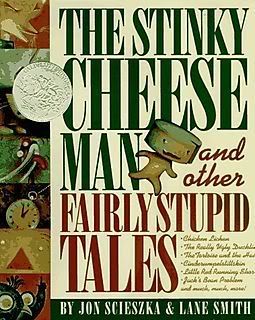 The author of many distinctive children's books beloved for their subversive humor -- the best known is "The Stinky Cheese Man and Other Fairly Stupid Tales" -- the 53-year-old former schoolteacher was the perfect choice for the first ambassador. Besides the fact that he's infectiously funny, he already was an ambassador of sorts, having demonstrated his commitment to a larger promotion of reading than the average author on tour by starting up Guys Read, a nonprofit literacy program aimed at males of all ages.
Scieszka (pronounced "Sheska") took up the scepter in January. "The fun thing about this position is that there never was an ambassador before. I get to make it up as I go along. At one of my first appearances, David Shannon [author of "No, David!" and many other books], who was with me, taught a roomful of kindergartners to do the ambassador's salaam. There's nothing like 300 kids bowing and waving and going 'Salaaahhhm!' I try to make the adults salaam, too, but that's harder."
The main idea of the ambassadorship, he explains, "is to connect in a way we don't always [manage] as children's book authors and illustrators. We tend to stay in our own self-imposed ghetto. We talk to each other, but that's preaching to the choir. We have to get out there to the mass audience."
 He's been trying to find more creative -- crazier -- ways to reach readers. This summer, he headlined a Guys Read Extravaganza at a Minnesota Twins baseball game.
"The Hennepin County Library has been a big supporter of Guys Read," he said. "They took the template and ran with it. That's what I had hoped would happen with Guys Read. They knew the county commissioners and the owners of the Twins were community-minded, so they set up this event. We gave away 'Time Warp Trio' books [a series Scieszka wrote with frequent illustrator Lane Smith] donated by Penguin to the first 5,000 kids who came in the gates. I was set up at a table and signed books during the first innings. Kids would come up and ask me: 'Hey, aren't you the "Stinky Cheese" guy?' They weren't baseball books, but the message was: Here's a guy who's a fan of baseball and books. You can be both."
As one of six brothers, Scieszka has a particular interest in boys' relationships to books.
"We were all crazy boys, but there was a whole range of readers," he said. "I was always a good reader, and I saw what that could do for you. I went to Catholic school through the 9th or 10th grade. The teachers' attitudes were always, 'Oh, that wouldn't be Jon getting in trouble in the back of the room, he's such a good reader!' So it would be my friend Tim who always got whacked. It's helpful to be the reader, I learned.
"Then I was an elementary schoolteacher for 10 years, and I saw firsthand that boys had a harder time getting into reading. I also have a son and daughter of my own. It was almost stereotypical -- my daughter [Casey, now 24] was crazy about reading, and my son [Jake, now 22 and a student at NYU] . . . not so crazy."
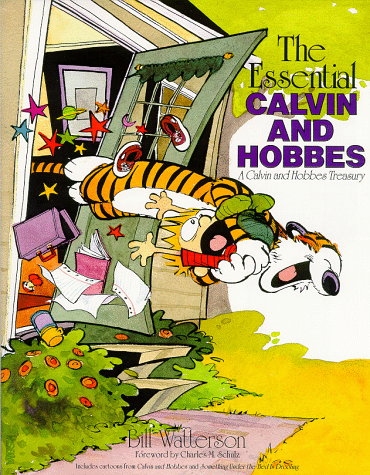 One of the widest planks in Scieszka's ambassadorial platform is to broaden adults' ideas of what reading is, and he observes how much more weight his tips seem to carry coming from Ambassador Scieszka than from Author Scieszka. "My first tip is to include not just fiction in your idea of reading. Include graphic novels, include "Calvin and Hobbes." Third- and fourth-grade boys devour those -- and they're really sophisticated, but parents will say, 'Oh, that's not really reading.' "
Scieszka calls this a "William Bennett position": "If they're not reading Greek myth, don't let them do it at all."
But Rick Riordan's Percy Jackson series, Scieszka says, "Is Greek myth," or at least a way into it. "I first saw fairy tales in 'The Rocky and Bullwinkle Show,' and they sounded kind of familiar. Then I read the fairy tales. Then I wrote my own books [in which he often, in a smart-alecky way, fractures traditional stories] and messed them all up for everyone. Now that's got a happy ending!!" he says, cheerfully anarchic.
Scieszka considers the debate about what qualifies as "real reading" a red herring. Online reading is certainly reading, he asserts, and it's foolish to ignore new media, as it is the new frontier in publishing: "Everyone's kind of chasing it, but no one knows what it's going to look like yet." His own "Trucktown" series for beginning readers has a website with interactive games, which he hopes will develop into a social site on the order of Webkinz. He is curious to see how Scholastic's forthcoming multimedia project, "The 39 Clues," will fare, and he has his own project in the works ("Spaceheadz," scheduled for 2009), in which kids will have a say in the development of a story through reading blogs, examining pictures and offering feedback.
"It may seem like heresy," says the ambassador, "for the children's literature ambassador to say reading is not the be-all and end-all. But kids could be watching great TV, designing their own video games, or making their own animation." It's all good brain work, he believes.
To finish this article, click here.