

 Posts
Posts


(Clears throat, rests hands on either side of podium)
We all notice the color of someone's skin, be they a cousin, a co-worker, an acquaintance or an artist. And whether we like to admit it or not, our behavior, demeanor and conversation are often altered by it -- even if it's only slightly and unintentionally. If we were to take an accounting of our acquaintances, it's safe to say that the majority of us would find that most of our friends shared our skin color. After all, isn't there some truth to the lie that someone who looks/dresses/talks like us has more in common with us than someone who does not? But if we allow ourselves to play it safe, to put up walls around ourselves, to hermetically seal ourselves in a stagnant social and cultural casket, we're, in a word, f**ked. Not only are we sowing the seeds of ignorance in ourselves (with ignorance being the root of racism), we're robbing ourselves of a broader intelligence, an expanded empathy, and a wider variety of life experiences. And for what? To avoid having our preconceptions challenged? Where's the fun in that?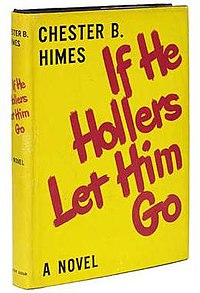
Another thing that makes this segregated reading style so nuts? We're living in a world where Black movie stars, athletes and musicians are considered to be the arbiters of cool. So why are the biggest, so-called 'hippest' faces in the literary world almost all White? In today's hip-hop-centric society, it would seem like keeping the status quo in such a state of stasis would actually require some effort. Or is it just the fact that 99% of the literary world's gatekeepers -- be they agents, interns, publishers or bookstore owners -- are bookish White folks who never really grew up exposing themselves to anything other than the bookish White by-products of other bookish White folks? Could the publishing industry's lack of prominent, young Black writers simply be the result of its historically White world view?
Anyway, that's my admittedly overly-simplistic two cents on what is obviously a complicated and controversial topic. Author Carleen Brice, the main brain behind White Readers Meet Black Authors, has plenty of her own ideas on the subject, all of which she presents in a series of thoughtful, conversational, and un-accusatory posts (wholly unlike mine!). Listed below are a few of my favorites:
The similarity between Black authors and Dr. Seuss' Whos.
In response to Newsweek's recent 50 Books for Our Times, they've complied a list of 40+ Books that W.R.M.B.A. Suggest You Read Now.
An introduction to authors writing about slavery in a manner that is neither guilt and/or shame-inducing, nor old-fashioned in its approach.
The 12 days of Christmas, Hanukkah and Kwanzaa -- specifically day 5's recommendation, Getting Mother's Body by Suzan-Lori Parks. I am so getting this book now.
A discussion about 'What constitutes a Black book?' that starts with a 'Which one of these things is not like the others' game and ends with one of the most thought-provoking comments threads...ever.
*It's also true that our male customers mainly buy books by male authors, our female customers primarily buy books by female authors, our Black customers buy books mostly by Black authors, and our gay customers tend to favor gay authors. In a future post, we'll do our best to address all of these self-imposed parameters. But for now, let's try and stay on topic, okay?
Tuesday, July 21, 2009
White Readers, Meet Black Authors
(a book blog recommendation)


Tuesday, June 9, 2009
Cover Art Cavalcade: Charming Cheesecake
You want a guaranteed bump in hits for your bookstore's blog? Take a major comic book company to task for their artistic take on strong females. I suspected as much when I was assembling last week's Covert Art Cavalcade, but I've gotta admit, I was expecting a wholly different reaction. I'd assumed that our comments section was going to be inundated with irate fans of teen T&A, but with the exception of one comment on our LiveJournal page, literally every response* focused on a fact-checking error I'd made. (I'd mistakenly claimed Supergirl: Cosmic Adventures was being canceled, when, in fact, it was always intended to be a limited series.) Hell, even that one comment on our LiveJournal wasn't defending the content of the cover art. It was introducing the "cheesecake" concept to the conversation, and asking whether or not those covers fit into it. To quote:
I think you're overreacting to those covers a bit. Cheesecake is a comic art staple, always has been and always will be, more or less. This is true of beefcake, also, which can be seen as just as demeaning to males as cheese is to females.
The important questions about cake are, in no particular order:
1. How good is it, as art?
2. Does it cross the porn line, wherever that might lie for the audience you're aiming at?
3. Does it add or detract from the story?
I'm gonna answer these questions in reverse order, but first, let me say that the guy who made this comment -- A. Tannenbaum -- is right. There is good cheesecake. It's just that, with the exception of Gotham Sirens, the comics that those covers were being used to sell had nothing to do with the cheesecake concept. I mean, Batgirl and Supergirl are comics about, well, girls. Either DC is making a grievous error in their idea of what types of comics young girls want to read, or they're intentionally making comics which sexually fetishize underage women. Or both. In which case, they're schizophrenically attempting to sell sluts on the cover and strong girls in the inside, effectively killing sales to both the young females and the old pervs. (Then again, Supergirl is currently at issue #44, so maybe I'm underestimating the mainstream comics audience's ability to continually fall for the ol' bait and switch.)
Gosh, I can ramble. Let's save ourselves another poorly constructed paragraph and just consider that the answer to questions 2 & 3, okay? As for question 1, the quality of the art, that's entirely an aesthetic call. Still, if the Supergirl artist wanted to attend a couple of life drawing classes, it probably wouldn't hurt.
Just to re-iterate, I have nothing against cartoon titillation...except where it relates to teens, tweens, tots and zygotes. That's why, in an effort to shake our new found, schoolmarm, internet image, I'm dedicating this week's Cover Art Cavalcade to some of comics' best cheesecake. Unlock your office's NSFW filters and enjoy!
Luba's Comics & Stories #1 by Gilbert Hernandez
Penny Century #7 by Jaime Hernandez
The Hernandez brothers draw bigger, curvier, sexier women than almost everyone else in comics. Not only that, they draw explicit sex scenes! So why don't the feminists hate them? Because the characters that the Hernandez brothers create are not defined solely by their sexuality. They're well-rounded and fully-realized...and I'm not just talking about their bodies! Ba-dump-bump. Seriously, though, if you've never read any of the Hernandez' Love & Rockets books, I cannot recommend them highly enough. Start with Gilbert's Heartbreak Soup, a Gabriel García Márquez-ish exploration of the residents of the fictional Mexican town of Palomar (and a huge influence on Junot Díaz' The Brief Wondrous Life of Oscar Wao). Then, when you think that there's no way that you could possibly love another comics character as much as you love Heartbreak Soup's Carmen, move on to Jaime's The Girl from H.O.P.P.E.R.S. collection. There you'll meet Maggie: master mechanic, punk rocker, comic book collector and emotional mess. (For reviews of some of Jaime's recent L& R books, see the aforementioned A. Tannenbaum's reviews here.)
Vampirella #1 by Frank Frazetta
Empowered#1 by Adam Warren
These two books are unabashed cheesecake at their finest. Heck, they don't even attempt to transcend their T&A roots, choosing instead to embrace it, wringing it of all its possibilities. Vampirella is a horror comics staple that has been published -- on and off -- since 1969. Countless authors and artists have used her to varying degrees of success, yet one thing has always remained the same: The skimpy red outfit.
Empowered is a more recent inductee into the cheesecake pantheon. It's the brainchild of artist Adam Warren, who's manga-influenced takes on American superheroes once inexplicably bothered the hell out of me. Then, one sunny day, I happened across Pop Culture Shock and Kevin Church's reviews of Empowered #1, and my curiosity was piqued. Four books later, I'm still a frothing fan of Warren's sweet and silly parody of the quote/un-quote "Super-Babe."
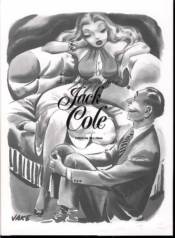
The Classic Pin-Up Art of Jack Cole
The Pin-Up Art of Dan DeCarlo
Ah, the classics. Just look at that line work! And the layouts! And those hips! Jack Cole, for those who don't know, was the creator of Plastic Man, as well as one of Hugh Hefner's favorite Playboy cartoonists. Giving Cole's Plastic Man and pin-up work a lurid twist, rumor has it he was impotent.
Check out the face on the girl in the stockings. Look familiar? That's because Dan De Carlo was one of the premier artists on Archie, Betty & Veronica, and Josie & the Pussycats. DeCarlo's seemingly simplistic approach to drawing female faces is still echoed by many cartoonists working today, including Love & Rockets' Hernandez brothers.
*Update! Since this screed was scribbled, we've received two comments actually pertaining to the topic at hand -- the cover art -- and not my continued need for an editor other than me, a few hours later.
Related and recommended:
Noah Berlatsky's Adding Incompetence to Insult
Laura Hudson's Comic Book Cheesecake: When Does Sexy Get Sexist?



Monday, March 30, 2009
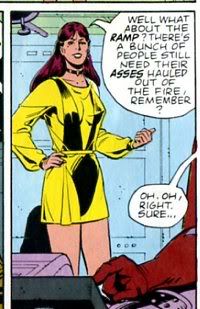
Am I Seriously The Last Person On Earth To Realize That Watchmen's Laurie Juspeczyk Intends To Become The Comedienne?
I was just reading an article over at The Hooded Utilitarian in defense of Alan Moore's female characters. Apparently, some folks think Moore crafts crappy dames, despite the fact that he's probably created more multifaceted (and just plain fascinating) female characters than just about any other comic book writer (outside of the Hernandez Bros. and Charles Schultz).
So anyway, I was reading the article, totally agreeing with everything that the author was saying, experiencing that subtle ego boost one gets when one reads their opinions expounded upon in a way in which one is incapable of doing oneself, when I came across this: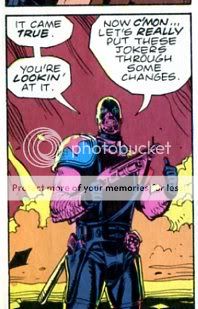
Wait. Whoa. Hold up a second. How did I miss this the first five times I read Watchmen? I consider myself a pretty aware fellow, yet somehow I never took Laurie's line to mean anything more than, 'I've gotta get something more protective than this sheer skirt.' Am I the only one? A quick read through the article's comments section would seem to insinuate I am. And what's worse, I LOVE THIS BOOK! I can't imagine what I might've missed in the books I only mildly adore.
But am I the only one that this has happened to? Has anyone else ever missed something so obvious, so significant, in a book they've read multiple times? And if so, would you care to share? Anonymous admissions of obliviousness may be submitted to the comments section below.
Tuesday, March 24, 2009
Cape Author's Book Threatens Georgia Town's Gentility
Via WRCB TV:
Parent Complaint Removes Book from Ringgold Middle Library
by David Carroll
RINGGOLD, GA - Ringgold Middle School's library includes one less book after a parent filed a complaint over "inappropriate content."
The book is The Burn Journals by Brent Runyon. Although critically acclaimed, the book's opening pages include several uses of the "F-word," a passage about a boy sliding his hand down a girl's sweater and pants, a crude slang reference to a girl's breasts, starting a fire in a school, a theft of school supplies, a girl's menstrual period, teen suicide attempts, and a boy setting himself on fire.
Quick question for the child-rearin', God fearin', folks of Ringgold, GA:
With the exception of the "F-word" (and maybe sweaters), doesn't the Bible make mention of everything else in your complaints list? Hell, the Old Testament alone has sex passages galore, breasts being referred to as pomegranates, an angelic arson in the cities of Sodom & Gomorrah, the theft of gold chalices, livestock and Joseph's coat of many colors, at least two mentions of menstruation, multiple references to both suicide and murder, and a guy who prepares a human-sized spit so's he can slow roast his son in a sacrifice to God.
Now, I know what you're gonna say:
I urge you to take the time to (re-)read the book. While it's true that many parts are disturbing (it's about Runyon's failed attempt to kill himself, after all), none are romanticized or unnecessarily lurid. It's actually a beautiful and compassionate book. A book that doesn't talk down to kids, but to them, and in doing so, attempts to help them through the always tempestuous emotions accompanying adolescence.
This book was written to keep kids from hurting themselves and others. You'd think that parents would applaud such a thing.
Previously on our blog: Author du jour: Brent Runyon
Tuesday, February 24, 2009
The Publishing Industry Is Killing The Undead Genre...Before It's Even Risen From Its Grave!
According to today's Shelf Awareness email, the buzz surrounding Seth Grahame-Smith's Pride and Prejudice and Zombies has been strong enough to inspire a new genre -- 'Monster Lit -- and a slew of hastily conceived knock-offs. Among them:
A Wuthering Heights in which Catherine returns as a ghost to terrorize Heathcliff.
A Jane Eyre title that features more than an insane wife in the attic.
A Mill on the Floss "powered by human sacrifice."
Unsurprisingly, only one of these knock-offs has actually been written. But then, maybe that's already one 'Monster Lit' title too many. After all, the media has pretty much pushed Pride and Prejudice and Zombies to the point of overexposure -- and the book isn't even out yet. If all that this newly minted genre has to offer after P&P&Z are uninspired rush-jobs written by publicity-hungry hacks, then the public and the press are going to lose interest pretty quickly. Personally, I'll be pissed if I never get to see the recently announced Hollywood horror film, Pride & Predator. Supposedly, it's being produced by Elton John, who will also supervise the music.
Seriously.
(Editor's Note: Isn't this what the kids used to refer to as, 'Jumping the shark'?)
(Author's response: If by 'the kids' you mean the forty-year-olds who frequent Facebook, then yes.)

Thursday, February 19, 2009
Inkwell Interjects
I know I just criticized the Christians yesterday, but this little bit of b.s. was just too insane to pass up. Self-publishing magnets, Xlibris, recently put out a press release listing 5 Tips for Successfully Publishing a Christian Book. The tips range from the ultra-obvious to the Jesus-Christ-why-am-I-even-reading-this?! ridiculous. In lieu of posting a Book News full of layoffs and bankruptcy notices, I decided to reprint it below, adding my own antagonistic interjections where applicable.
Enjoy!
Successfully Publishing a Christian Book
Christian books are written for a specific purpose, for a specific audience. Knowing how to go about it will ensure your success in publishing a book on Christianity.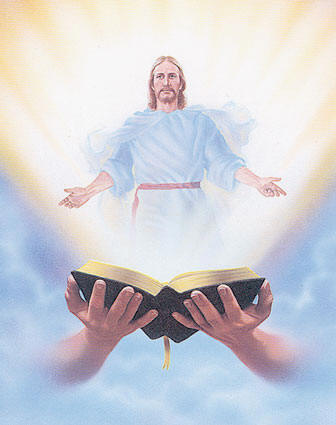
First, try to conceptualize the kind of book you are writing. Penning a Christian book does not mean you can just babble off religion like it is daily fodder for the rumor mill. Christianity basically means living a life based on the teachings of Jesus Christ and holding true to the Christian faith. If you are to write a book with these essential elements, then you are already headed in the right path. Your book will be as lively as it is entertaining; inspiring as it is educating.
Inkwell interjects: In other words, if you're going to write a quote/unquote "Christian book," make sure it's about either Christ or Christianity. Thanks for the clarification, Xlibris!
Second, your interaction with the Christian community adds to the foundation of your Christian values. Living the Christian lifestyle will always give you credibility as an author of a book on Christianity. However, communicating with a community of fellow believers will provide you with more knowledge and information on the Christian life that will be valuable for your written work. The truths that you glean from others will strengthen your book’s trustworthiness. Anecdotes will also give your book a personal touch as do quotes from real people.
Third, pray. Ask for guidance, focus and inspiration. If you are writing a book on divine matters, then you are going to need divine inspiration. Once you receive direction and guidance for your book, you can then begin your outline.
Inkwell interjects: Pray for 'divine inspiration'? Priceless! Oh, and your editor's gonna love this, too. As your completed manuscript will be, in effect, The Word of God, they won't have to fix a thing. (And if they try? You know they're doing the Devil's work.)
Fourth, be resourceful. Do not just rely on the Internet to help you with your content. Books about Christianity from published authors also are good content aids. Organize your materials and set a writing schedule. Add flavor by placing in your own experience with Jesus Christ – nothing beats personal encounters with the Lord in conveying your message to your audience. A detailed but not too lengthy testimonial will help you connect with your readers more.
Inkwell interjects: Yes, simply copying information from other sources may not be enough when writing your own book. You may have to resort to -- gasp! -- using your own ideas and experiences. (Of course, this would seem to contradict the 'waiting for divine inspiration' mentioned in tip 3, but whatever...)
Fifth, find a publisher. Once your manuscript is all set, search for a publisher and comply with their submission guidelines. Make sure they have services that will help you target your book to the right audience.
With these guidelines, you are well on the way to a becoming a successful author of a Christian book.
Inkwell interjects: Wait, what? "Find a publisher"? Isn't that supposed to be a pretty tough thing to do? I mean, why would they be on a self-publishing website if finding a publisher seemed in any way possible?
(Prays, waits, prays again.)
Ohhh. I get it, Xlibris. You're just testing their faith.
Thursday, February 12, 2009
Grim Times Bring Great Art...Right?
An excerpt from: Life in Comics: Can Creativity Save Comics from Troubled Times?
In the 1930s, while people were struggling with poverty and confronting the looming threat of fascism, Siegal and Shuster invented a (Super)man who did not have to struggle and who used his power for the benefit of humanity. In the early 1980s, when the economy was failing but the country had no clear moral battle on the horizon, alternative comics began to take on, as Charles Hatfield writes in his book Alternative Comics: An Emerging Literature, "the exploration of searchingly personal and at times more political themes."...What will troubled economic times bring us this time around?
To read the entire article, click here.
Monday, February 9, 2009
Inkwell Interjects
Brief backstory: While reading the following article this morning, I literally snarfed my coffee. I immediately wanted to respond to some of the more ludicrous statements made by the speakers quoted, but couldn't think of an even-handed way of doing so without basically reprinting the whole piece. Then it hit me: Why not re-print the whole piece, inserting my opinions as I went along?
So's I did.
All bold print is from the original article. All anorexic print and the accompanying illustrations are mine.
(Oh, and a special note to Brice Wallace, the author of the article:
Please don't sue me. I'm not criticizing you here. I'm only criticizing the folks you quoted.)
Technology is a new chapter for booksellers
By Brice Wallace
Originally published in The Deseret News on Friday, Jan. 30, 2009
Chalk up booksellers as another industry group challenged by new technology, but they were encouraged on Friday to jump aboard the tech train rather than compete with it.
A panel at the opening of the American Booksellers Association's winter get-together suggested that booksellers see technology — such as e-books — as an opportunity rather than a threat.
"We've all got to figure out how to use online to make our businesses work," Bob Miller, president and publisher of HarperStudio, part of HarperCollins Publishers, told a group of about 450 people in Salt Lake City.
Nan Graham, editor-in-chief of Scribner, said booksellers need to "figure out" their "territorial role" in the e-book industry. Panelists suggested a few ways booksellers can do that, including serving as guides and experts for their customers.
"All you need to do is shout-outs every day for things you think are of value. You all have expertise as influencers that you have to make use of online," Miller said.
"There is so much noise out in the marketplace and people are asking for direction — how to find the stuff that's worthwhile — and you guys do that," said Morgan Entrekin, president and publisher of Grove/Atlantic Inc. "You take ownership over your business, because you have a knowledge base of your local community. And I think that that's going to create great opportunity for you."
Panelists said all independent booksellers need to blog as a way to capitalize on their expertise. One bookseller said a video blog propelled a local wine seller to online prominence, expert status and huge sales for his business. "When we say you should blog, we really mean that a 20-year-old on your staff should," Miller said, evoking laughter from the audience.
Miller said such use of technology may not produce results quickly, but it also is not expensive. "It costs (virtually) nothing to do, but nobody's doing it," he said.
Miller also said booksellers should not expect customers to pay full price for various versions of the same book. His preferred model is a customer buying a book and, while at the register, paying a little more for an e-book version and a little more for an audio book version. "Capture that sale in your store at the register," he said. "If we set up a battle between the digital and the physical, physical will lose."
Inkwell interjects: This is terrible advice. Record stores (remember them?) briefly tried this, and we all know how well that worked out. No one wanted to go to a store to purchase a song off of iTunes when they could do the same thing from home/work/via their cell phone. The same argument can easily be applied to e-books.
Oh, and about audio books -- they aren't going to provide miraculous monetary salvation to any bookstore. Last year, 'real world' retail sales made up only 27% of all audiobook purchases. And the numbers are dropping. It is foolish to try and sell 'new media' using the old methods.
A couple of panelists cited statistics to keep the e-book threat in perspective. Roxanne Coady, owner of an independent bookstore in Connecticut, said that if e-book sales doubled annually for the next five years, they would total $1.2 billion but still account for only 5 percent of total book sales.
Entrekin predicts e-books to be 3 percent to 10 percent of total book sales in five years. "I'm not quite so convinced that the e-book thing is going to tilt as wildly as some people in the industry are," he said. "Our customers are from six months old to 105 years old, and a large range of those people are not going to quickly move to digital or electronic."
Entrekin said people worldwide "are getting more literate every day, every hour, every minute," and they will eventually turn to books because they are "where the repository and the discourse of our society are."
And bookstores "are the places that are beautiful, wonderful places to go to in the community," he said. "You know, we can't all live online all the time."
Inkwell interjects: I know that I'm coming off like an antagonistic assh*le here, but the fact is, the future of brick and mortar bookstores isn't pretty. To try and deny this in an effort quell the fears of folks making their livings working and operating them is just wrong. Spouting blue-sky bullsh*t like, "People worldwide are getting more literate every day, every hour, every minute, and they will eventually turn to books because they are where the repository and the discourse of our society are" and "Bookstores are the places that are beautiful, wonderful places to go to in the community," solves nothing. Pretty platitudes do diddly to help bookstores survive during a time of technological change and economic uncertainty. Previous ABA panels/seminars provided practical advice, but it seems like all that was offered here were simplistic suggestions and self-important self-affirmations. Hell, if that's all it takes, they could've just passed out Tony Robbins tomes and 'Hang In There' t-shirts and saved everyone a lot of time and money.
One more thing: Even if you disagreed with everything I interjected, please give the author of the original piece their proper click-through count by clicking here. Thanks!
Monday, January 12, 2009
WTF?!

Egad.
What were they thinking?
Tuesday, December 16, 2008
10 Tips from a Former Traveling Sales Rep
...Part 2!
If you missed the first half of AutumnBottom's epic, two part guest column, click here. And shame on you for arriving late to the party.
The Final Five -Sales Pitch-
We reps think it's wonderful when buyers have looked at the catalogue before we come in and you already have an idea of the titles that interest you and the numbers you might want to order. It's amazingly, wonderful helpful. That said, stay flexible. Or at least give the appearance of flexibility. We've worked hard on our sales pitches and, chances are, the books that we actually HAVE a pitch for are important. It's just nice to have a receptive audience.
-Complaints-
Everyone loves to complain. I'd say it's the "great unifier" because nothing brings people together like kvetching. The company I worked for had a very...unique catalogue. It was about 16 inches tall, 10 inches wide, and 200 pages of flimsy newsprint. Putting a positive spin on it, I'd say something like, "It certainly is easy to spot!" But really, it was just a gigantic pain in the ass, and my buyers never hesitated to let me know.
Chances are, if you have to say to your rep, "I don't know if anyone has ever complained about this..." they have heard it a million, billion, trillion times over. At every single meeting I got a complaint about the catalogue. No, wait, I lie. There was one meeting with a design store in Beverly Hills where the buyer loved our catalogue. Silly Californians.
I'm sorry, where was I going? Oh yes. Complain about the catalogue to me all you want. Complain about having to pay freight or how we print our company's name on the cover of every book, but please, don't punish me for it. As a lowly rep I simply do not have the power to change these things. My buyers telling me that they wouldn't order books until we changed the catalogue just made me think they were jerks. But don't tell them I said that.
-Keep Your Appointments-
I toyed with the idea of making this heading "Keep your *fucking* appointments" to drive home the importance of this topic. As a traveling rep I cannot even begin to describe how annoying it is to take the time and effort to fly somewhere 1,000 miles from home and have the person you were supposed to meet cancel on you when you show up at their store. I completely understand cases of sickness or other emergencies, but when it's simply because you forgot to tell the babysitter that you needed her until 4 pm.... I had one guy in LA who would cancel on me almost every time and it was always because he'd already gone home and didn't want to fight traffic to come back "so maybe we can meet next time you're in LA". Gah!!!!
-Pass Along the Kind Words-
There is almost nothing better than praise. I loved, reveled really, in being told by my customers that they loved meeting with me. I loved that they felt taken care of by me and that I cared about them and their businesses. It was even better when I heard from my boss that one of my bookstores had taken the time to call New York to let her know that I was doing a good job. Something like that goes a long way in assuring job security and letting the muckity-mucks know that the people in the field are taking care of the customers.
-Always Use a GPS-
So this one has no bearing on you, the bookstore, whatsoever. But should a new traveling sales rep happen upon this list, this is the most important thing ever. Buy a GPS and take it with you wherever you go. Expense it, write it off on your taxes, or just eat the cost of it, but it is the most valuable tool in your arsenal.
The first three or four trips I went on, I printed out a veritable encyclopedia of MapQuest Maps and spent all my time in the rental car with my head buried in those print-outs and a map provided by the rental car company. I didn't see any of LA, Calgary, or Portland. But on a fateful trip to Denver I was offered a GPS unit at the rental counter and my life changed. I was able to drive around the city admiring the buildings and the mountains and avoiding pedestrians while a pleasant Englishwoman fed me turn by turn directions. I stopped at Best Buy on my way home from the airport and picked up one to take with me wherever I went.
It made my travels so much easier knowing that when I stepped off an airplane in a strange city I could just plug in my little friend (God that sounds dirty) and I could navigate the city like a native. My greatest fear while traveling was not that the planes would crash and burn or my buyers would block the doorways of their stores (that did happen to a fellow rep of mine) but that I would forget my GPS at home and be completely, utterly lost. See what technology hath wrought?! Anyway. GPS is a gift from God. Go buy one.
Again, if you dug what Autumn wrote, PLEASE CHECK OUT HER LIVEJOURNAL! Homegirl is mad funny and she posts regularly. Oh, and if you work in a bookstore, make sure you print this out and show it to your travelling sales reps. It'll make them feel loved.
Monday, December 15, 2008
10 Tips from a Former Traveling Sales Rep
Ah, a guest column. These are always fun. Fun for me, the blogger, because I get to slack off in my duties. Fun for you, the reader, because my shtick is getting stale and y'all have been craving something better...you ungrateful bastards. Anyway, today's column was written by former traveling sales rep and current bookseller AutumnBottom. (That's her LiveJournal name, anyway. Witness Protection rules prohibit us from divulging her true identity.) If you like what you read here, make sure to check out her LJ. She's funny as f*ck and a brand new mom. Oh, and she's got cool hair, too. The trifecta! Autumn's caveat: I was only a sales rep for 1.5 years with one smallish publisher, so I can't say for sure if this list would apply to a seasoned veteran of Random House or Simon & Schuster. Besides, I wasn't a particularly successful rep having had a bit too much empathy to push hard for the big sales. But anyway....
- Sales Numbers-
As reps, we're the low-man on the sales chain totem pole which means that we report to sales managers who, in turn, report to points higher on. I was constantly struggling with trying to please my bosses whose sales mantra was "Don't take no for an answer," and trying to maintain my trusting relationships with my bookstores. I guess what I'm trying to say is when your rep is trying to convince you to take a display with 20 copies of a $50 book and seems to keep circling back around to it after you thought you'd moved on, it's because of the pressure from "on high" and not because your rep is an asshole.
-Freebies-
Ask your rep for sample copies. Always. It never hurts to ask and, more often than not, they can get it for you. And, as was often the case with me, remind your rep about your request after a couple of weeks if you still haven't seen your freebie. It's totally not that we don't like you. It's just that we're busy people and things sometimes slip through the cracks.
-Loneliness-
Being a traveling sales rep is a lonely, lonely experience. It only took one week of business travel for the luster to wear off. Sitting in a restaurant by yourself is fun on occasion but when you do it for two to three weeks out of every month.... I was eternally grateful for the few buyers that I became friends with and could count on socializing outside of a business context with when away from home. If you like your rep, and you're willing, invite them out for a beer after work. They'll love you for it and be even more willing to go the extra mile for you.
-High Heels and Weak Arms-
I am all of 4 feet 11 inches tall. For my job I carted around a suitcase filled with 60 lbs of art and architecture books. By the time I finished hauling it out of the trunk of my rental car, dragging it through the gravel of the parking lot, and bouncing over the sidewalk into a store, the last thing I wanted to do was carry it up three flights to the buying office. If you are a brawny buyer and your rep happens to be wearing high heels or shops in the petite department please, please, please, offer to carry their suitcase.
-Free Lunches-
One of the major perks of being a buyer is having your rep take you out to lunch. There is nothing like free food in the middle of your day! However, if you've only bought three books out of the catalogue, for the love of Pete, don't order the lobster in truffle sauce. I'm not saying you need to satisfy yourself with the bar nuts, but try to order according to...well...your order.
Oh, come now. You didn't think I was going to give you all of Autumn's awesomeness in one fell swoop, did you? And rob myself of a second day of slacking off? Not a chance. If you want to read The Final Five Tips from a Former Traveling Sales Rep, your punk asses are gonna have to come back here tomorrow. Until then, you can visit Autumn here.
Added on 12/16: Link to part 2
Friday, April 11, 2008
Books on the Nightstand
 Michael Kindess and Ann Kingman, two of our favorite sales reps (Random House), have a new blog called Books on the Nightstand. Now the whole world, not just New England booksellers, has the opportunity to partake of their special blend of passion, insight, and sheer enthusiasm for books! Listening to their podcasts made me want to take the day off and read for the next 10 hours straight. They are that persuasive when talking about books and authors that they love. Check out their blog & podcasts the next time you crave a good book. (Two books I'm adding to my must read list based on their suggestions are: Any Human Heart by William Boyd and Peace by Richard Bausch.)
Wednesday, December 12, 2007
Not Books...
R.I.P. Ike Turner
You had some serious demons in you, demons that you never did get completely under control. But you were a genius, an undeniable musical visionary, and Tina never sounded so good without you.
Wednesday, November 14, 2007
In Defense of Third Person Omniscient
Yesterday, a customer asked me if I could find him some recent fiction written in the third person omniscient point of view. ('T.P.O.' as I'll refer to it from here on out, is when a story is told from the perspective of a god-like narrator who can see every character's actions and thoughts.) My initial reaction was, damn, what a stupid way to find something new to read. Then I set off around the store to find one. But you know what? I couldn't. Not one. It seems that the majority of the novels being published today fall into one of two p.o.v. camps: first person ("I did this," "I went there," etc.) and third person limited (a character's name is used instead of "I", but chapter to chapter, scene to scene, we get to 'hear' the thoughts and 'see' the observations of whichever character is being featured).
So what the hell happened to T.P.O? Looking around online, the majority of folks seem to deride it, calling it "head-hopping," or "lazy writing." Another common claim is that publishers frown on it because it "creates...distance between the reader and the story," while "making it hard to form any emotional attachments to the characters."
Well, I say mother-eff those folks. T.P.O. is the Robert Altman of fiction -- a unique and exciting way to experience the lives of a wide variety of characters, all at the same time. And to call it "lazy" is ludicrous. Switching back and forth between the p.o.v. of a group of characters in a manner that never confuses...that's anything but easy. Jane Austen used to use the T.P.O., and she's no slacker. J.R.R. Tolkien did, too, and he was a literature professor. Hell, even your mother and/or father used T.P.O. when they told you bedtime stories, and that supposed 'distancing' never stopped you from peeing the bed in terror, did it?
In closing, let me pass on this quote from Molly Maquire, herself quoting Stephen Koch. The two of them sum it up perfectly:
"Whenever arguments over the sanctity of certain POV protocols arises, I think of Koch's take on the furor:
'Too often, this rather fussy doctrine pointlessly constricts writers’ options and narrows their range. As for the claim that the reader can’t follow multiple or shifting points of view, it is simply false on its face. The whole history of the novel is testimony to the contrary, from Jane Austen to Thomas Pynchon. In masterpiece after masterpiece, the narrative point of view readily changes from page to page, or even from sentence to sentence and only delights as it does so. In fact, one of prose fiction’s grandest strengths, which it exercises for once in effortless superiority over all other narrative media, including the movies, is its ability to dart in and out of any character’s mind at will. To forgo this splendid artistic advantage in the name of some pallid academic theory is really madness.'–Stephen Koch, The Modern Library Writer’s Workshop, page 90"
Tuesday, October 2, 2007
We Sell 'Banned Books'
(but only after the ban is over)
(and only if it's politically correct to do so)
Banned Book Week is the book industry's annual celebration of their own self-satisfaction and self-importance. Bookstores everywhere (including us) hang signs in their windows and around their stores boasting that THEY. SELL. BANNED. BOOKS. They get a 
Wednesday, September 19, 2007
Ode to Independents
by Cristin Cali
I was driving down Rt. 149 the other afternoon and noticed that there was a pizza delivery car in front of me. I was amused by the colorful decals plastered all over the car, advertising an adorable, eager-to-please restaurant. For some reason, I started to draw parallels between the pizza business and the independent book-selling industry.
We’re all aware that the big pizza chains are Dominos, Papa Gino’s and Pizza Hut. As a little kid in the late 80s, I remember those three restaurants being the King, Queen and Prince of the pizza world. On a cold or miserable rainy night at the end of a long day my parents would sometimes resort to take out or the occasional delivery. When we ordered from the chains, each pizza would taste exactly the same every time, without the slightest variation.While there may be something comforting about the predictability of a franchise, there’s nothing particularly memorable or special about it either. On the other hand, while growing up in West Barnstable, I would frequently make a pilgrimage (one exclusive to children under the age of fifteen) to the Old Village Store. Whenever I would round the corner (after stopping at the library, of course) I would eagerly anticipate the sight of the maroon building and the dusty scent of its old wooden floor.
Next to the Village Store was the most unassuming pizza parlor, appropriately named Old Village Restaurant and Pizza. I remember it being extremely small, with an Old World atmosphere. In the summer, a batch of strong, tall sunflowers would flourish in front of the quaint little porch where people would sit and devour their massive, piping hot slices.
I attribute my fond memories of Old Village Pizza to the gruff, wrinkled woman who barked orders behind the counter, the romantic ethnicity of the place, and its perfectly sparse decorations. That one restaurant evokes more charm and memories than all of my experiences with the large franchises combined.
So, in thinking about all of this while I was stuck behind the delivery car, I concluded that independent bookstores and humble, locally owned pizza places are quite similar.
I’ve been in the large chain bookstores and they are all the same, no matter where I go. Such homogenized businesses send a shiver down my spine, because they lack warmth and feeling. However, there are still (thank goodness!) plenty of unusual, charming, independent bookstores out there for adventurous book lovers to discover and celebrate.
It takes more time and effort to go to the unique places where we’ll be most likely to have a memorable, truly enjoyable experience. If you are able to spend time finding such precious gems, you will be rewarded with the creativity, quirks, passion and most importantly, the humanity that’s exclusive to independent shops around the world.
Wednesday, September 5, 2007
Do Bookstore Employees Dream of Shelving Philip K. Dick Novels?
We are now two days into our nine month hibernatory slumber. The self-reflective imagery that we had so eagerly looked forward to has already proved entirely disappointing. It lacks vividness and grows fainter with every passing hour. What were we thinking, asking for answers? There are no lessons to be learned in the downtime.
Shrill snippetts of garbled voices echo and drift in from the street. They belong to the lost and not the looking. I offer direction, but they crave only directions. Don't they know who we are? What we are? What we can do?
I step outside to check: Has our once proud sign fallen into disrepair? Have the shadows stretched so far as to obscure the letters, making our mission moot?
Or is it true what scientists say: That no one reads in dreams?

Tuesday, September 4, 2007
What Does Your Store Do?

Yesterday I posed a challenge to the members of my staff. I wanted each of them to try and think of an idea/gimmick/scam/kidnapping plot to attract a fresh, new audience to our bookstore and win back the crusty bottomed crowd that would rather sit at home and shop than peruse the aisles of a local indie. We already do in-store book signings and readings, as well as the seasonal museum tour or two. These work well, but we're noticing that it's the same faces attending every time. We've also been doing out-of-store events, mostly due to the tireless promotional work of one our store's best handsellers, Kay. These, too, have been highly effective. But now we need something new to add to our arsenal. So we're putting the question out to you, the readers.
As a bookstore employee/owner, what does your store do to attract a crowd?
And as a bookstore shopper, what sorts of things do you look for in the stores that you frequent?
Friday, August 31, 2007
3 Day Weekend?
It's hard not to jealous of the 9-5ers. I've been in retail so long that I don't remember what it's like to have a 3 day weekend off. On the Cape, this is the last gasp of summer and the end of our busy season. So no posts this weekend, we'll be back on Tuesday along with the rest of you lucky dogs. Hope you remembered to pack a good book.
Tuesday, August 28, 2007
Marginal Graffiti
Are you the sort of reader who jots notes in the margins of the books that you're reading? Do you underline passages that hit a raw nerve, or witty one liners that you plan to wow your co-workers with at the next office party? Have you ever written something totally unrelated -- say, a phone number or grocery list -- in a book, simply to avoid getting up from the comfortable position you're sitting in?
If so, stand tall. You've nothing to be ashamed of.
Unlike those folks who only open their books partway so as to avoid creasing the binding, you're actually enjoying your reading experience. Hell, you've taken it to the next level, making it an interactive activity. What's more, you've proven yourself to be such an avid reader that while loving and respecting literature, you've also made it into a natural extension of yourself. Think of it this way: you write stuff down on the back of your hand all of the time, don't you? The fact that you're able to draw quick police sketches of shady individuals on the inside cover of your airport read only proves that you are books and books are you.
So to hell with the haters who scoff at scuffed bindings and your corner-of-the-page flip book adaptations. They've never experienced the joy of picking up an old paperback, only to find the pin number to a long lost checking account with fourteen dollars plus interest accrued. Nor have they ever tasted their own vomit after opening up an old book of poetry and seeing their freshman year knockoffs iambic pentametered in the blank spaces.
Sure, you'll never be able to sell (or even give away) your unwanted books for fear of the cringe-worthy secrets that you wrote in the margins seeing the light of day, but honestly, is there really such a thing as an unwanted book? When I look around my dusty old mansion, piled from floor to ceiling with books that might benefit needy schoolchildren, I remind myself that once a book has been vandalized...er, personalized, it's a part of me. As such, the inevitable donation and/or disposal of my ballpoint battered books will be handled under the same stipulation with which I have agreed to donate my organs.
Only after I'm dead.
(For my preferred crematorium and a map to the spot where I'd like my ashes scattered, see the margin of page 152 of my copy of Exquisite Corpse: Surrealism and the Black Dahlia Murder.)


