

 Posts
Posts


via boing boing:
SomethingAwful.com holds a weekly Photoshop. This week's theme -- 'Children's book covers made demented.' All of the entries are twisted and obscene, and the best part is, half of these books would actually sell to adults!
via Nelson Guirado.com:
What's the Al Qaeda book club reading this month? American forces reportedly found this illustrated 'how-to torture' manual in a terrorist safehouse in Iraq.
via popmatters.com:
The perfect book for all those moms whose body piercings got in the way of their breastfeeding.
Saturday, May 26, 2007
Weekend Links: The Not For @#%!'n Kids Edition


Friday, May 25, 2007
Book Review: Grant Morrison's New X-Men Omnibus

Up 'til about the halfway mark, I was enjoying it simply as a much-better-than-average superhero book, but I knew that I still hadn't cracked the underlying lesson, the secret parable, what Morrison has referred to as the "inoculation of ideas" that he is trying to deliver in his comics work. So I went back to the beginning of the mammoth volume and started skipping through the pages, reading random word bubbles here and there, until it finally hit me. This book, like mutation itself, is about evolution. Not just the aforementioned 'second evolution' that changes the appearance of the Beast from a pointy-haired monster into a more feline Beauty & the Beast creature, but the evolution of the X-Men comics themselves -- and superhero comics in general.
If the way I read it was correct, Morrison appears to have devoted his entire 42 issue run on the series to questioning its relevancy, trying to put an end to the artistically repetitive rut it had fallen into, and steering it in a completely new and previously unimagined direction. (This comic book crusade must have seemed all the more gutsy and blasphemous at the time, as the X-Men comics were still the best selling comic books in America week to week!) To spur on the book's own evolution, Morrison re-introduced many of the series' more tired and/or far-fetched tropes (Professor X's intergalactic love affair, Magneto's grandiose plans to rid the Earth of humans, Wolverine's endless quest to find out his past), bringing them to their logical conclusions and thereby creating a clean slate for future writers of the series. He also took many of the one-dimensional characters and, by adding a bit of a dichotomy to their personalities, made them much more complex -- again, giving future writers any number of new themes that they might tackle should they so desire. For example, by having the Cyclops character begin to question his role as leader of the X-Men and his love for Jean Grey, Morrison has created a new cipher for thoughts on personal, romantic and group responsibility. By tossing former nemesis Emma Frost into the X-Men, issues of trust and questions as to a person's ability to truly change can now be more readily played around with. The most direct calls for the comic's continued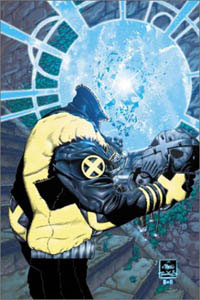
(I plan to reread the New X-Men omnibus in a month or so. If anyone has tips as to ideas, themes, etc. that I might want to look out for on my second go-round, please drop me a note in the comments section.)
Update: The Gardner Linn Fanclub has a thorough and amazing analysis of the series. It's well worth neglecting a little more of your 'real' work to take the time to read.
For a nice, long interview with Grant Morrison, click here. You'll be re-routed to Popthought.com.
Thursday, May 24, 2007
Definition of the Deckle Edge

She also found out this little bit o' history:
"A deckle is a wood frame resting on or hinged to the edges of the mold that defines the edges of the sheet in handmade paper process. According to history.com, the rough edges are created by the fibrous pulp flowing between the frame and the deckle of the mold. When books were predominantly composed of handmade paper, deckle edges were considered a defect and were trimmed off. In the late 1800s, however, rough trimmed pages became fashionable. During this time, many books were left untrimmed on one or three sides for purely aesthetic reasons."
Is it only a matter of time before the E-books try and replicate this, as well?
Wednesday, May 23, 2007
It's The End Of E-Books As We Know Them! (Oh, Wait...You Weren't Aware Of Them Yet? Nevermind, Then. Skip To The Next Post)

That said, the damn things fascinate me in a morbid, know-in-advance-how-you're-going-to-eventually-die sort of way. I mean, it would be undoubtedly cool to have a library of your favorite books all in one small device, in much the same way that the ipod serves as a personal, portable juke-box (shout outs to all the struggling indie record stores -- we feel your pain, brothers!). Ah, but at what cost? I already step over the sleeping bodies of far too many former booksellers on the way to work every morning. One has to wonder, do the mad scientists behind these cold, unfeeling digital book machines have any moral code that they answer to?
Antonio Tombolini, an Italian internet entrepreneur, recently focused his evil genius on
One Goes Through An Awful Lot Of Airsickness Bags In 25 Years Of Travel Writing

While you're over there shamelessly begging for handouts, make sure to read the accompanying interview with Rough Guide founder, Mark Ellingham. He comes off as a nice, smart guy (but his library, pictured to the left, could use a little bit more variety).
Tuesday, May 22, 2007
Generically Titled Entry Featuring Nothing But Randomly Assorted Links
Oprah's dad is writing a tell-all book. I'm hoping that James Frey offers to co-author it.
Simon & Schuster to use 'American Idol-like' voting system to help choose what books they're going to publish. My opening chapter is going to be all about Celine Dion, my mom that died of something tragic, my little sister -- whom I adore, and my sorority. Go, Alpha Betas! Woo-hoo!
Japan to hand out 'Nobel Prize of manga' this summer. Expect a gold statuette with reeeaaally big eyes.
Monday, May 21, 2007
My Editor Used To Say That She Wished She Could Take A Pair Of Scissors To My Work. Could This Have Been What She Was Referring To?
 From Boing Boing, via IZ Reloaded:
"Minnesota photographer Thomas Allen cuts illustrations from the covers and interior pages of pulp novels and kids' books, turns them into 3D scenes and photographs them. As a director would stage actors, Allen stages his cut-outs in ways that create humor, tension, mystery, and drama. A boxer fights his own shadow in Spar, and in Bookend a gunfighter stands over his recently fallen opponent. Although the characters are freed from the closed pages of books, the books themselves still remain present in each photograph. A ship sails across the curved pages of a dictionary-sized book in Swell. In Cover, a gunman finds safety behind the spine of a book, and in Recover, a worn paperback acts as a life raft to three weathered shipwreck survivors."
The mind reels at what this guy could accomplish with my older brother's collection of girlie magazines...
To check out a cool slideshow of some more of Allen's work, click here.
Sunday, May 20, 2007
A Review Just for You: Coelho's "Witch of Portobello"
.jpg) The Witch of Portobello marks a great stylistic departure from The Alchemist. I was pleasantly surprised to observe Coelho's authorial skill and flexibility. The language and format of Witch of Portobello is more sophisticated and therefore left no doubt in my mind as to the deliberate, almost childlike simplicity of The Alchemist.
The Witch of Portobello marks a great stylistic departure from The Alchemist. I was pleasantly surprised to observe Coelho's authorial skill and flexibility. The language and format of Witch of Portobello is more sophisticated and therefore left no doubt in my mind as to the deliberate, almost childlike simplicity of The Alchemist.
Coelho is obviously interested in presenting his readership with themes involving the pursuit of dreams, spirituality, contentment, etc. He examines such ideas by featuring main characters who actively seek the aforementioned themes, often showing his characters struggle and fight the vast majority's opposition and condemnation.
Witch of Portobello is a novel written in documentary format and features a magnetic, enigmatic, unconventional protagonist named Athena. Athena's character is unveiled through a series of intriguing interviews* featuring her acquaintances, family, friends and lovers. Certain aspects of the interviews may seem difficult to rationalize or accept, as the dialogue frequently teeters on the edge of unbelievable.
The above is all very indicative of Coelho's work. In order to enjoy and appreciate it, you've just got to --as my favorite English teacher often said-- "willingly suspend your disbelief." If you can't muster up the effort to do so, Coelho's work probably isn't for you.
Coelho's passionate dedication to propagating the message "follow your dreams" is what makes him so interesting. I don't mean to sound like some kind of book evangelist. That sort of thing really irritates me, so I hope this review isn't having that effect...However, I believe "there's a hat for every head" and if you find a way to extract all of the hype surrounding Coelho and his work, reading only for yourself, then you might find something entertaining and valuable within his simple, compassionate message.
The Witch of Portobello was just released on May 15th, so stop in and see if we have any left in stock! I'm sure Alchemist fans will love Coelho's latest tribute to freedom of the human spirit. If you've read anything by Coelho and have any opinions about his work whatsoever, feel free to comment up a storm. Either that, or stop by the Inkwell and chat up a storm. I'm expecting some kind of storm here, folks. Don't disappoint me!
*Readers who enjoy novels featuring a variety of voices and perspectives might also enjoy Getting Mother's Body by Susan-Lori Parks and My Name is Red, by Pulitzer prize winning author, Orhan Pamuk...(not to mention nearly everything by William Faulkner).
Saturday, May 19, 2007
Just When You Thought Big Business Was On The Side Of The Little Guy...
I sometimes wonder why blogs post links to articles like this, warning unpublished authors what to be wary of should Simon & Schuster come calling. Let's be realistic, the only thing unpublished writers really need to be concerned with on that dream-a-little-dream day when S&S comes after their mildewing manuscript is that they don't accidentally stomp the dog/baby/roomba while they run to the door to sign their lives away.
Yes, what Simon & Schuster is attempting to do -- 1.retain control of books even after they have gone out of print, 2.consider a book in print, and under its exclusive control, so long as it's available in any form, including through its own in-house database -- even if no copies are available to be ordered by traditional bookstores, 3.be able stop printing a book and prevent the author from publishing it with any other house -- bears all the ugly hallmarks of corporate greed, but guess what? They're a corporate enterprise! If you want to avoid the evils of big business, avoid big business.You don't send Disney your ideas for an updated Mickey Mouse (five fingers and a post-pubescent voice!) and expect a fair shake, do you? Beggars can be choosers. The alternate phrasing of this cliche was birthed in a boardroom.
Daniel Gilbert's Hints To Finding Happiness (For Answers You'll Have To Buy His Book)
Earlier this week, Daniel Gilbert was awarded some sort of cash-heavy statuette for his book, Stumbling on Happiness. In this video interview, the author speaks to nobel laureate Harold Varmus about the science and philosophy behind turning a frown upside down.
(Interview appears roughly halfway through the program. First up is a brief chat with Robert Altman and Garrison Keillor.)
Friday, May 18, 2007
When The Inkwell Talks, Oprah Listens

You see what we're talking about?
No, not the recent release of Chabon's new novel. We're referring to the fact that the Inkwell blog just dedicated a whole day's posts to promoting The Yiddish Policemen's Union and the curly-locked dreamboat who wrote it. Yeah, it seemed a little fishy to us, too, so we made a couple of calls to find out the gossip behind the gossip. Our first call was to Harpo Productions, Oprah's multi-million dollar company. Identifying ourselves as her beau, Steadman, we were rudely brushed off by an underling. On our second attempt, we deepened our voice and claimed to be Gayle King, Oprah's best friend and personal 'Johnny Drama.' This time our call was immediately forwarded to the Big O herself, who, after laughing with us about having just avoided a call from 'clingy Steadman,' confirmed
Initial tip via: The Comics Reporter
Thursday, May 17, 2007
Had He Lost, His Next Book Could've Been About Sadness

From the BBC report:
Discussing the winner, Professor Colin Pillinger said: "Daniel Gilbert's voice provides a witty companion throughout this exploration of the science behind the pursuit of happiness. He uses cognitive science and psychology to provide intriguing insights into human nature, helping us to understand why we make the decisions we do."
Gilbert himself was thrilled to take the book prize. "I'm absolutely delighted to receive this tremendous honour from the world's oldest learned society," said the Harvard University psychology professor. There are very few countries (including my own - the US) where a somewhat cheeky book about happiness could win a science prize - but the British invented intellectual humour and have always understood that enlightenment and entertainment are natural friends. So God bless the empire!"
Easy, tiger. You already won. Oh, that's right -- happiness is your shtick, innit? Poetry Contest Scandal Rocks Japan! Toilet Themed Haiku Robbed Of First Place Prize!
via: Guardian UK:
Heated toilet seats, pension worries, nagging wives and neglected children were among the most popular themes among this year's offerings of "senryu", haiku-like verse that take a sideways look at the fears and foibles of the put-upon Japanese white-collar worker, or salaryman.
The Dai-ichi life insurance firm, which has run an annual salaryman senryu contest for the past 20 years, today awarded first prize to a verse that alluded to Japan's collective fear of growing old with a reference to the popular Nintendo brain training games:
Nou nenrei
Nenkin sudeni
Moraemasu
Or, roughly translated: My brain age is already old enough for a pension.
The second-place entry was a tribute to the ubiquitous "washlet" lavatory, tinged with a melancholy only a salaryman can know: The only warmth in my life is the toilet seat.
Third prize went to a bitter commentary on Japanese society's relative affections for middle-aged men and pets. Referring to the widely televised rescue of a stranded dog last November, it laments: How good it is to be a dog: even when trapped on a cliff, someone saves you.
The contest is open to all, although most of the entries are either written by salarymen themselves, or by others who draw on demanding bosses, distant families and money worries for inspiration.
To read the whole article, click here.Speaking of Award Winners, Here's a Shoe-In for Next Year's Top Honors
Disappointed by the fact that they had to finally bury her body and could no longer parade it around for photo-ops and beyond the grave interviews, the folks who brought you the paternity case of the 2007 now bring you the book of 2008. Bookstores can expect it to be delivered by four horsemen dressed in apocalypticly themed attire.
Wednesday, May 16, 2007
Our thoughts on BEA - Because Everyone is Asking
 "Are you going to BEA?" I'm sure every bookseller out there has been asked that question a dozen times. For those not in the business, BEA stands for Book Expo America. It is the second largest show devoted to books, after the Frankfurt Book Fair. 30,000 people in the business of publishing and selling books gather to network, party, promote, and connect during a long weekend in early June.
So are we attending? The short answer is no. The long answer includes varying reasons why not:
- 1. We don't like to leave our store at the beginning of our busy tourist season.
- 2. Because we rely on our visiting sales reps to show us the important books we may miss when reviewing the seasonal catalogs, we don't need to browse the enormous sales floor at the convention. So although walking the gauntlet of publishers is fun (who doesn't love the occasional free book offered up by those running the show tables?), it's not necessary.
- 3. The cost of getting there, staying there, eating there, is prohibitive.
- 4. I really hate getting up early!
- 5. We are a smallish new store, and that makes us feel invisible (and slightly ridiculous) at such a huge event. Our regional trade show (NEIBA) fits us better.
The obvious answer is yes, and here are our reasons:
- 3. To meet kindred spirits who share their insights and travails with you is our third favorite part of trade shows.
- 2. The educational programming provides us with tools and new ideas to bring back to our store.
- 1. Celebrating the world of books and the incredible passion of everyone involved in this industry is a tonic which has the power to renew our flagging energy. Running a small business (and reading in general) is a solitary business.
Tuesday, May 15, 2007
Generically Titled Entry Featuring Nothing But Randomly Assorted Links
Billionaire writer's thriving cult threatens, "If Harry dies, we don't want to know about it until J.K. Rowling decides to tell us. We own pitchforks, hot wax and feathers. And we're not afraid to use them."
Neil Gaiman (Sandman, American Gods) shares his photos from Alan Moore's (Swamp Thing, Watchmen, From Hell, just about every other comic book I've ever loved) wedding to Melinda Gebbie (Lost Girls, Cobweb).
Tim Lucas' Mario Bava biography is due in July! (I've been owed this as a birthday present for two years now.)
Katherine Hepburn would've turned 100 this past Saturday. William Mann, the author of Kate: The Woman Who Was Hepburn (Henry Holt 2006), discusses the saucy dame in the NYTimes.
The perfect idea for writers who hate having to write, publishers who hate having to publish, and readers who hate having to read.
Monday, May 14, 2007
In Hopes of Selling Lots of Copies of Michael Chabon's Newest Novel, 'The Yiddish Policemen's Union,' We're Going to Drown You in His Internet Hype

In an essay about the 1958 travel guide "Say It in Yiddish" in Civilization magazine, Michael Chabon contemplated a country where "I'd do well to have a copy of 'Say It in Yiddish' in my pocket." Of course, not only had Chabon not found such a place but, he pointed out, "I don't believe anyone has."
Chabon, it seems, couldn't get this phantom Yiddish-speaking nation out of his head, and now he's gone and created the place himself. Welcome to Sitka, Alaska, the setting for his new novel, "The Yiddish Policemen's Union," where the only "American" spoken is swear words. In this imaginary world without Israel, Sitka plays temporary home to Big Macher department stores, a thriving Chassid mafia, and some 3 million very cold Jews.
If less epic than "The Amazing Adventures of Kavalier and Clay," for which Chabon won the Pulitzer in 2001, "The Yiddish Policemen's Union" is no less ambitious. In addition to being a Chandleresque murder mystery, it deals with the Messiah, a secretive cabal not unlike the apocryphal Elders of Zion, Jewish-American relations and the perennial question of what it means to be a Jew. If all this sounds like too much, you may be right. But, as is the case in most of Chabon's novels, it is his characters, at once absurd and 
Salon caught up with Chabon in New York, a place he still fancies as "'Kavalier and Clay' land," where he spoke about why he likes being called anti-Semitic, what it's like being married to another writer, and why he's obsessed with Barack Obama.
For the full interview, click here.
You're Too Discerning to be Swayed by an Interview? How About Some Unbiased Reviews?
The New York Times seems to dig the new novel, praising his imaginative setting, characters, and metaphors (always the tipping point in a book's purchase, no?).
New York Magazine likes it, although they, too, feel that Chabon was "limited by the detective story’s familiar machinery."
The Boston Globe is a little less effusive, complaining that "too often Chabon's affections -- for the elegant enigmas of chess, for the modern tragedy of the Jews, for verbal acrobatics and literary shenanigans -- turn into a wild display of warring talents, compromising the structural integrity of the novel and turning its hair pin plot twists into a drive off a cliff." Keep in mind, though, that this 'structural integrity' complaint is made in a fifty-one word sentence.
The LA Times gives it a 'thumbs-up', saying that it is "a spiritual descendant of (Chabon's Pulitzer prize winning novel) Kavalier & Clay," and "a book that expands on the sensibility of the earlier novel and its roots in Jewish storytelling."
Saturday, May 12, 2007
Weekend Links

via: Cartoon Brew:
"Imagine if there was a New York Times Book Review that exclusively covered inspiring art and illustration books. Well, there is such a site and it’s called Book By Its Cover. The site has a broad focus, everything from children’s books to comics (to animation books) and hand-made books, and the selections are pure quality."
Authors On Tour Live offers podcast interviews with an impressive array of writers in both traditional download format and mp3. Their most recent interview is with Nick Bantock, author of Griffin & Sabine and Windflower. Also available are podcasts with Jim Lehrer, Les Claypool and Erik Larson.
And while we're recommending podcasts, Science Fiction fans will want to head over to Escape Pod, an impressive SF site that is currently running podcast readings of all of this year's Hugo Award nominees. (If this last tip is a bit too geeky for you to comprehend, ask Inkwell Michelle. She speaks a variety of nerd languages, including Klingon.)
The preceding tip was stolen from: Boing Boing
Use our comments section to let us know what literary sites/blogs you frequent. If you have any ideas for our weekly 'theme' days (authors, genres, etc.), feel free to write those in, too.
We'll see you bright and early Monday morning. Until then, read whatever -- just read.
Friday, May 11, 2007
Sex Sells, But Modern Readers Prefer Violence

"During the 1960s, a series of court decisions made it possible to publish just about anything. A burst of sex-centered novels followed. But about twenty years ago, many readers became sated with sexy novels. After all, sex is no longer the mystery it once was. And that's when the thriller entered the literary mainstream."
Then again, Freud would insist they're both the same thing, wouldn't he?
Subscribe to:
Posts (Atom)
