

 Posts
Posts


Saturday, July 14, 2007
What Makes Sammy Stall?


Friday, July 13, 2007
News Bits, In Brief


Update: Unpack your bags. While regular book prices in Canada will go down, comic book prices have gone up.
Updated update: Re-pack. Turns out, it's only Marvel Comics' prices that have gone up. The last great book that they put out was canceled in 2004.
Yeah, but I went to Syd Field's seminar, and he says that writers need a three act outline and a strict adherence to the 27 minute rule. And he's rich! (Proving once again the old adage that 'Flannery will get you nowhere.' Ba-dump-bumb.)

Reclusive Nobel Laureate Publishing Latest Novel Online

Associated Press
Published July 4, 2007
VIENNA -- By some measures, Elfriede Jelinek's world is small. The reclusive Nobel literature laureate cloisters herself inside her homes in Vienna and Munich, Germany, and rarely ventures out in public.
But online, the Austrian writer -- who suffers from what she has described as a "social phobia" -- connects with ease to people around the world. Little wonder, then, that she chose to debut her latest novel on the Web rather than in bookstores.
"I find the Internet to be the most wonderful thing there is," Jelinek said in an e-mail interview with The Associated Press. "It connects people. Everyone can have input."
Jelinek, 60, has been posting chapters of the new book, "Neid" (German for "Envy"), as she writes them. The first two chapters of the work she describes as a "mixture of blog and prose" are already available on her site, www.elfriedejelinek.com, and there are more to come.
"It's a wonderfully democratic method, publishing a text on the Internet," Jelinek told the AP.
Link to Elfriede Jelinek's website
(From the AP, published in The Chicago Tribune, linked to via: Boing Boing)
Thursday, July 12, 2007
News Bits, In Brief
The estate of Ian Fleming is flogging a horse, a dead horse.
Did Jim Morrison die in a bathtub in Paris, a nightclub restroom, or all of the above? (The truth is apparently more Weekend At Bernie's than Oliver Stone's The Doors.
Authors tired of tour buses and cruise ship signings are now heading...to Wal-Mart? Yes, who needs integrity and pride when you've got a pharmacy, hair salon and yellow trash bags full of stale popcorn all in one dirty-diaper scented superstore!
Via The Comics Reporter: Joss Whedon's first Runaways comic is now online. Read it for free, then buy the second issue at your local bookstore or comic book shop.
Rock 'N' Roll Book Reviews

From Bloomberg.com: "When Warren Zevon was diagnosed with terminal lung cancer in 2002, the rock star ordered his manager, Brigette Barr, to exploit his illness in any way that might bolster his soon-to-end career. In those last months, Zevon recorded a final album, 'The Wind,' which included a version of Bob Dylan's 'Knockin' on Heaven's Door.' He told friends he wanted to die quickly to help it get nominated for a Grammy. (It won two.) He returned to heavy drinking, after 17 years of sobriety, and begged Crystal to write an honest biography with nothing airbrushed out, she says. She apparently took him at his word. I'll Sleep When I'm Dead describes how Zevon, who died in September 2003, aged 56, minimized sleep and maximized drugs, guns and women. He toted a .44-caliber Magnum, beat his wife, raged at his children and lamented his commercial failure compared with acquaintances such as Jackson Browne and Don Henley of the Eagles, the book says. The book balances this lurid account with Zevon's good side: A hard-working songwriter, Zevon is hailed as a genius by celebrities throughout the book. Browne says Zevon had 'literary muscle.' Bruce Springsteen cites his dedication. Stephen King, Gore Vidal, Bonnie Raitt and David Crosby add their praise. Crystal reports that Zevon was dismayed when 'Werewolves of London,' written as a throwaway, was chosen as a 1978 single over more crafted alternatives such as 'Tenderness on the Block.' The book shows how Zevon produced magic in the studio, though it's less insightful about how he could even function. Taken together, it makes an eloquent case for the rocker's reassessment and rehabilitation."
From PopMatters.com: "The book’s formula is simple: Zuaro takes us through many types and portions of food, from morning through late at night, and writes a short preface for each recipe about both the band and the food in question. Most entries also include quick words from band members, but the most entertaining include lengthier quotes or, even better, recipes fully written in a band member’s distinctive voice. Zuaro’s cookbook...marries an independent, DIY ethos with the sometimes exotic, sometimes wearying rock-and-roll touring lifestyle. In her introduction, Zuaro explains that she started collecting rocker recipes after realizing just how much the sometimes-literally starving artists she interviewed as a journalist appreciated food."
says Entertainment Weekly: "Des Barres profiles two dozen fellow band-aids in an exuberant attempt to rehab the word groupie, from harlot to muse. The veracity of these raunchy tales is up for grabs, but the claims of Kurt Cobain's cross-dressing and Chuck Berry's scatological obsession are scandalously entertaining. The tone of Let's Spend the Night Together seems to be celebratory — one fan admits to having sex with 30 musicians in one night — but the utter emptiness of these women's lives emerges most clearly, even if they don't believe they've been used. 'They wanted us there,' says one woman of her music idols, 'and they treated us like goddesses.'"
From The Guardian UK:
"The blindly evangelical phase of my Clash obsession came to an end sometime during their seven-night residency at the Lyceum in the autumn of 1981. For the first time it seemed that one of us, and maybe both, was going through the motions. I missed the White Riot tour and had spent four years making up for it. Acquiring a copy of the limited edition "Capital Radio" EP meant that pension planning would be something for other people. (In fact they fetch about the same £50 today as they did a quarter of a century ago.) Wresting possession of one of Topper Headon's drumsticks from a scrum of skinheads at a gig in Cardiff - monogrammed "Topper's Boppers", which was a surprise - was to get hold of a holy relic.
The Clash fizzled out ignominiously a few years after that underwhelming night at the Lyceum, having morphed into the Clash Mark II, aka "the dodgy Clash". But looking back I still don't find that four-year crush - for that is what it must have most resembled - embarrassing. During those years the Clash, and Joe Strummer in particular, changed lives like no band since and very few before. Those lives might well have changed again a few times, but that extraordinarily potent combination of idealistic heart-on-sleeve leftwing politics, perfect pitch musical heritage and impeccable rebel style was utterly irresistible to a certain sort of male who came to musical consciousness sometime in the late 70s. When Strummer died aged just 50 in 2002 it was easy to pick out plenty of other paunchy, greying fellows looking lost and misty-eyed.
Chris Salewicz's huge new Strummer biography captures well this sense of loyalty and loss. As an NME glory-days writer he draws on his semi-insider status - Strummer called him "Sandwich" - to provide a dogged soup-to-nuts detailing of the life. It can be hard going, but we learn a lot. Strummer's diplomat father wasn't quite the toff of legend. Strummer's despised public-school background provided him with very little in the way of an education. (Although his charisma and apparent self-confidence see him neatly fit into the tradition of former public schoolboys who rise to the top of radical organisations.) His politics came from the pre-punk 70s squatting and pub rock scenes - "more Merry Prankster than disciplined socialist". But the hippy reinvented himself in Brigade Rosse and H-Block T-shirts. And this being the Clash, there were not only songs, but also policies and edicts. However, as Salewicz puts it, Strummer was always the "personification of Carl Jung's view that all great truths must end in paradox". Despite the strident right-on-ness, he still went through more women than he did guitar strings. And that famous Telecaster was pretty battered. In 1983 the Clash were paid half a million dollars to headline an American festival. They performed beneath a banner that read "Clash Not For Sale". And just as Strummer wasn't really leading a revolution, he wasn't even really leading his own band. Mick Jones, despite his "Radio 2 tendencies", provided both musicality and a guilt-free, working-class radicalism that was disastrously missed when Strummer ousted him in 1983.
For someone who so persuasively urged communication, Strummer was apparently uncommunicative about his own insecurities. His elder brother - who had become obsessed with the occult and Nazism - had committed suicide. Strummer had his own propensity for depression. In the years after the Clash he acted in films, wrote soundtracks and fronted for other bands. But he had taken seriously his impossible role of filling the political and cultural voids of his followers and he soon found himself drifting, with an awful sense of self-awareness, into the limbo world of someone who used to be the voice of a generation.
The way Salewicz tells it, Strummer found a route back via the hippyish camaraderie of camp fires at Glastonbury, domestic stability and his new band, the Mescaleros, earning their own critical respect. The title of the book echoes a late collaboration with Johnny Cash on a Grammy-nominated version of the Bob Marley song, and five weeks before he died Strummer was joined on stage, for the first time in 19 years, by Mick Jones at a benefit for striking firefighters. The Clash were always masterful at shaping their own mythology and here was the circle made complete: Strummer at last at peace with both himself and his legacy. Salewicz deploys a vast weight of fact and opinion to point up this upbeat conclusion and, despite the nagging sense that he is wishing as much as knowing, you can't help but pray that he is right."
For five separate excerpts from Redemption Song, head on over to PopMatters.com via this link.
Wednesday, July 11, 2007
Have You Ever Read A Foreign Novel And Then Accidentally Written With An Accent?
 I recently read two wonderful books: If on a Winter's Night a Traveler by Italo Calvino (translated from Italian) and A Reading Diary by Alberto Manguel. Because I read one book after the other, I was struck by how prevalent and important translated literature is to each author. Manguel wrote, "The ignorance of the English-speaking reader never ceases to amaze me." He is alluding to the fact that so few books are translated into English and even the ones that are get missed. There are occasional surprise bestsellers like Suite Francaise by Irene Nemirovsky, and the Nobel Prize winner Orhan Pamuk's books all sell well, but mostly after he won the coveted prize. From a bookseller's perspective, it seems American readers are missing a whole world of books!
In the Book Babes column, Ellen Heltzel and Margo Hammond, the book editor of the St. Petersburg Times, each wrote a piece about foreign lit from opposing perspectives. Click here to read that article and check out their smart observations about the book industry.
Featured below are two excellent sites that encourage reading without borders:
Words Without Borders
"...Today, 50% of all the books in translation now published worldwide are translated from English, but only 6% are translated into English. Words Without Borders opens doors to international exchange through translation of the world’s best writing — selected and translated by a distinguished group of writers, translators, and publishing professionals — and publishing and promoting these works (or excerpts) on the web."
Reading the World
Now in its third year, Reading The World is an exciting collaboration between booksellers and publishers interested in bringing international voices to the attention of readers like you.
Tuesday, July 10, 2007
News Bits, In Brief

The BBC has launched a web page where you can hear poets read from their own work, and it's not emo kids reading MySpace odes to themselves, either. They've got Ogden Nash, W. H. Auden and Sylvia Plath among others.
Update: Apparently, Sylvia Plath has a MySpace page. For some strange reason, though, I suspect a hoax. For one thing, isn't she dead? And another, wouldn't the real Plath use more sad-faced emoticons?
Monday, July 9, 2007
If We Still Used Whale Oil, Nantucket Would Be As Wealthy As Dubai (And No One Would Ever Mention Building Wind Farms)

1. The fact that every book ever written about whaling -- fiction or non -- will inevitably be compared to Moby Dick.
2. The fast-approaching final installment of the Harry Potter series. There's still two weeks to go, but it is already sucking up the majority of America's book sale dollars like the immense whirlpool left in a diving whale's wake.
As the type of reader who sympathized with Ahab, I'd like to toss a floating coffin or two the underdog's way. Here's some links related to Dolin's book.
The New York Sun has nothing but kind words for the book, while adding this interesting aside to readers horrified at the idea of whaling: "Today's reader, taught by decades of save-the-whales activism to regard the slaughter of whales as a particularly gruesome form of exploitation, is inclined to join the whales' celebration. (In fact, the party was premature: As American whaling declined, Russian, Norwegian, and Japanese fleets took up the slack.) But Mr. Dolin, whose environmentalist credentials are impeccable — he is the author of the Smithsonian Book of Natural Wildlife Refuges — recognizes that modern taboos won't help us understand the history of whaling. He 'seeks to recreate what whaling was,' he writes, 'not to address what it is or should be now.'"
Author John Steele Gordon reviews the book for the Wall Street Journal. He digs it plenty.
The Los Angeles Times reviews it favorably, saying, "Leviathan will appeal most to history buffs and ocean lovers. Occasionally, readers may get lost in the details — it can be a bit like reading Moby Dick without the narrative — but what details they are! Exotic locations, colorful characters, melodrama and gore aplenty, but also food for thought."
To visit his website, stab your harpoons here.
Jazz Messenger by Haruki Murakami
I never had any intention of becoming a novelist — at least not until I turned 29. This is absolutely true.
I read a lot from the time I was a little kid, and I got so deeply into the worlds of the novels I was reading that it would be a lie if I said I never felt like writing anything. But I never believed I had the talent to write fiction. In my teens I loved writers like Dostoyevsky, Kafka and Balzac, but I never imagined I could write anything that would measure up to the works they left us. And so, at an early age, I simply gave up any hope of writing fiction. I would continue to read books as a hobby, I decided, and look elsewhere for a way to make a living.
The professional area I settled on was music. I worked hard, saved my money, borrowed a lot from friends and relatives, and shortly after leaving the university I opened a little jazz club in Tokyo. We served coffee in the daytime and drinks at night. We also served a few simple dishes. We had records playing constantly, and young musicians performing live jazz on weekends. I kept this up for seven years. Why? For one simple reason: It enabled me to listen to jazz from morning to night.
I had my first encounter with jazz in 1964 when I was 15. Art Blakey and the Jazz Messengers performed in Kobe in January that year, and I got a ticket for a birthday present. This was the first time I really listened to jazz, and it bowled me over. I was thunderstruck. The band was just great: Wayne Shorter on tenor sax, Freddie Hubbard on trumpet, Curtis Fuller on trombone and Art Blakey in the lead with his solid, imaginative drumming. I think it was one of the strongest units in jazz history. I had never heard such amazing music, and I was hooked.
A year ago in Boston I had dinner with the Panamanian jazz pianist Danilo Pérez, and when I told him this story, he pulled out his cellphone and asked me, “Would you like to talk to Wayne, Haruki?” “Of course,” I said, practically at a loss for words. He called Wayne Shorter in Florida and handed me the phone. Basically what I said to him was that I had never heard such amazing music before or since. Life is so strange, you never know what’s going to happen. Here I was, 42 years later, writing novels, living in Boston and talking to Wayne Shorter on a cellphone. I never could have imagined it.
When I turned 29, all of a sudden out of nowhere I got this feeling that I wanted to write a novel — that I could do it. I couldn’t write anything that measured up to Dostoyevsky or Balzac, of course, but I told myself it didn’t matter. I didn’t have to become a literary giant. Still, I had no idea how to go about writing a novel or what to write about. I had absolutely no experience, after all, and no ready-made style at my disposal. I didn’t know anyone who could teach me how to do it, or even friends I could talk with about literature. My only thought at that point was how wonderful it would be if I could write like playing an instrument.
I had practiced the piano as a kid, and I could read enough music to pick out a simple melody, but I didn’t have the kind of technique it takes to become a professional musician. Inside my head, though, I did often feel as though something like my own music was swirling around in a rich, strong surge. I wondered if it might be possible for me to transfer that music into writing. That was how my style got started.
Whether in music or in fiction, the most basic thing is rhythm. Your style needs to have good, natural, steady rhythm, or people won’t keep reading your work. I learned the importance of rhythm from music — and mainly from jazz. Next comes melody — which, in literature, means the appropriate arrangement of the words to match the rhythm. If the way the words fit the rhythm is smooth and beautiful, you can’t ask for anything more. Next is harmony — the internal mental sounds that support the words. Then comes the part I like best: free improvisation. Through some special channel, the story comes welling out freely from inside. All I have to do is get into the flow. Finally comes what may be the most important thing: that high you experience upon completing a work — upon ending your “performance” and feeling you have succeeded in reaching a place that is new and meaningful. And if all goes well, you get to share that sense of elevation with your readers (your audience). That is a marvelous culmination that can be achieved in no other way.
Practically everything I know about writing, then, I learned from music. It may sound paradoxical to say so, but if I had not been so obsessed with music, I might not have become a novelist. Even now, almost 30 years later, I continue to learn a great deal about writing from good music. My style is as deeply influenced by Charlie Parker’s repeated freewheeling riffs, say, as by F. Scott Fitzgerald’s elegantly flowing prose. And I still take the quality of continual self-renewal in Miles Davis’s music as a literary model.
One of my all-time favorite jazz pianists is Thelonious Monk. Once, when someone asked him how he managed to get a certain special sound out of the piano, Monk pointed to the keyboard and said: “It can’t be any new note. When you look at the keyboard, all the notes are there already. But if you mean a note enough, it will sound different. You got to pick the notes you really mean!”
I often recall these words when I am writing, and I think to myself, “It’s true. There aren’t any new words. Our job is to give new meanings and special overtones to absolutely ordinary words.” I find the thought reassuring. It means that vast, unknown stretches still lie before us, fertile territories just waiting for us to cultivate them.
The preceding was stolen whole from the pages of the New York Times, July 8, 2007.

Friday, July 6, 2007
When Refusing To Do Something Counts As Actually Doing Something, The Shiftless And Inert Become The Upwardly Mobile

And this is supposed to be interesting how?
Reading is the lazy intellectual's secondhand way of experiencing life. Books are supposed to transport us places we normally wouldn't go and show us things we otherwise would not have seen. 
Thursday, July 5, 2007
Bookcase Chic: Lining The Catwalks Of Milan
Sick and tired of trying to live a hip, modern lifestyle while surrounded by the same old-fashioned bookshelves your great-great-grandmother used to own? Check out these daring new designs, all of which are guaranteed to make your books look bolder, cooler and sexier -- and you along with them.



Wednesday, July 4, 2007
Tuesday, July 3, 2007
New Bits, In Brief

In related news, middle aged women everywhere have doubled the fatwa offer originally placed on Rushdie by the Islamic extremists. You go, girls!*
*Veils up, though, when you do.
The Surgeon General Warns: You're Not Just Reading That Book, But Also Every Other Book That That Person Has Ever Read

Monday, July 2, 2007
It's The Most Wonderful Time Of The Year (cue: gunshot sound fx)

I imagine the Wampanoags, the original inhabitants of the area, must have felt a similar feeling of woe when the Mayflower first came over the horizon. No longer were they autonomous humans with lives of their own, but complimentary, make-shift tourist bureaus, living solely to give detailed directions to their easily distracted, ADD-afflicted interlopers. I'm sure that the pilgrims had a lot of children who needed to go to the bathroom/have a glass of water/wanted to sit and read books for free with no intention of purchasing them, too. And they were guests, dammit, so why shouldn't they be allowed to? Is it documented anywhere whether the first words out of John Smith's poorly cared for mouth were "Do you have public restrooms?" or "Where's a cheap restaurant where I can get 5 star seafood?" Cuz I've got $5 riding on the first one and I'd really like to collect.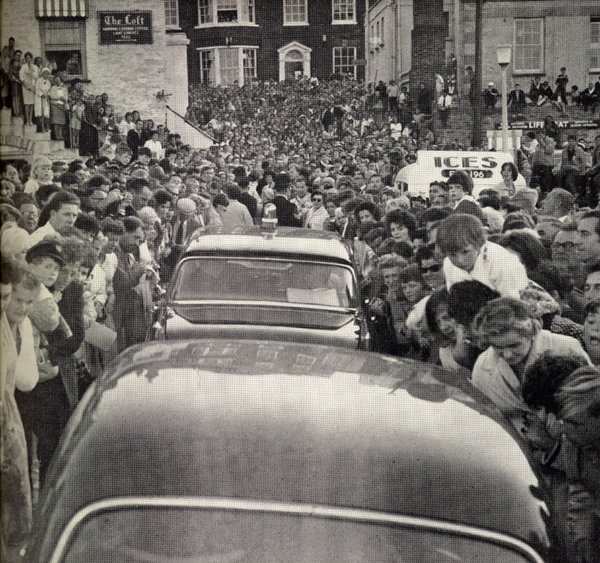
Another headache is the ludicrous expectations that many of these folks wash ashore with. In what bookstore, save one on the Harvard campus, would you be able to walk in and purchase a specific volume of untranslated 1970's Swedish psychology texts? And yet there are people walking in with requests as ridiculous as this every hour on the hour. You try to let them down easily, (a free cookie is a good way to start), but they will often take offense, as if you purposefully didn't have the book in stock just to make the writing of their thesis paper that much more of a challenge. What's worse is that they then tell you, "I'll try Borders," and then ask you for directions! I offer to tell them how to get to the Massachusetts border and leave it at that.
Hmn...Stockhlom. Now there's a place I'd like to visit someday.
(The second photo is actually of Falmouth, England, but I thought it apt considering the secession celebrations currently taking place.)
Note: For a longer, funnier critique of local tourism, check out Marcia Monbleau's wonderful The Inevitable Guest: A Survival Guide to Being Company & Having Company on Cape Cod.
Friday, June 29, 2007
Bookstizzore Contizzest

Pretty Soon Godzilla Is Not Gonna Have Any Bookstores Left To Stomp On

Chaco is becoming one of the most popular mobile phone novelists in Japan. We don't know much about her -- except that she's a twenty-something Pisces from Osaka -- but we do know that she can spit out books faster than Danielle Steel. In the last 14 months, she wrote five novels, including her best seller, What the Angel Gave Me, which has sold more than 1 million copies to date.
A mobile phone novel typically contains between 200 and 500 pages, with each page containing about 500 Japanese characters. The novels are read on a cell phone screen page by page, the way one would surf the web, and are downloadable for around $10 each. The first mobile phone novel was written six years ago by fiction writer Yoshi, but the trend picked up in the last couple years when high-school girls with no previous publishing experience started posting stories they wrote on community portals for others to download and read on their cell phones.
Next summer, the company will debut software that allows mobile phone novelists to integrate sounds and images into their story lines. Adding visuals and vibrations to romance novels' steamy sex scenes could bring the genre an even wider audience."
They Better Not Touch The Size Of Thor's Hammer!


Thursday, June 28, 2007
Hip Hop Lit
When I first started listening to rap music in the late 80's/early 9o's, it seemed like every MC had a favorite book or two that they would name drop incessantly in songs and interviews. On the East coast, rappers were pushing The Autobiography of Malcolm X and pamphlets detailing the teachings of Brother Clarence 13X. Out West, Eldridge Cleaver's prison memoir, Soul On Ice, was the undisputed book of choice. It was a time when even so-called 'thugs' boasted of their continuing self-education, and artists with thoughtful, literary lyrics were often those with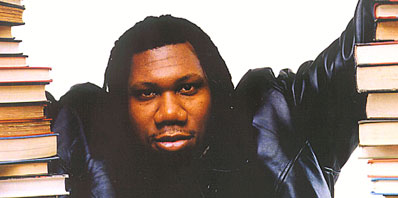
My how times have changed. These days, you're more likely to hear a shout-out for Phil Jackson's autobiography than Malcolm X's, and starting a clothing line has long since replaced the dream of spearheading a revolution. That's not to say that there aren't a few artists still stressing brains over ballin'. Mos Def, Talib Kweli, Dead Prez and Immortal 

From the book's website: Based on original interviews with DJs, b-boys, rappers, graffiti writers, activists, and gang members, with unforgettable portraits of many of hip-hop's forebears, founders, and mavericks, including DJ Kool Herc, Afrika Bambaataa, Chuck D, and Ice Cube, Can't Stop Won't Stop chronicles the events, the ideas, the music, and the art that marked the hip-hop generation's rise from the ashes of the 60s into the new millennium.
Bomb the Suburbs by William Upski Wimsatt
Written more like a collection of fanzine entries than a typical piece of non-fiction, Wimsatt covers topics as varied as train hopping, graffiti, rapping, breakdancing, train hopping and grassroots political activism -- all from the vantage point of someone who was there, actually participating in it before they ever thought of writing a book about it.
From E.T.: If the editors of Mad were hip-hop heads, they might produce a book as funny, irreverent, and indispensable as this one. It's just as well that they're not, since the obsessives at rap fanzine ego trip have already assembled what may be the most readable, humorous, and enjoyable tome about rap music and culture extant. Within these pages is a wealth of fascinating trivia and arcane knowledge. Several hundred howl-inducing entries -- including ''# of Times the 'N' Word Appears on N.W.A's Albums,'' ''8 Songs About Body Odor,'' and ''Rap Artists Who've Survived Shootings'' -- constitute a funky fresh and decidedly def history lesson. One proviso: If there are other rap fans living with you, you may want to keep this ultimate bathroom book in the living room.
Unbelievable: Life, Death & Afterlife of The Notorious B.I.G. by Cheo Hodari Coker
Coker conducted quite a number of interviews to flesh out this detailed and surprisingly even-handed biography of the late, great 'rap Alfred Hitchcock.' In an interview with the Stanford Daily, Coker says, "B.I.G. was the one person, where through his life you could explore the history of hip-hop. When you look at his art, its more than just a gangsta rap record, it is about Reagan-omics and drug use in the ’80s, and how that affected the content of hip-hop. I wanted to show who it is he was, but not shy away from the Biggie who pulled guns, smoked weed and had more girls than any man should. When he got big, he was not only able to have music change his life, he brought in the people from the corner and showed them that instead of risking your life for $20,000, I can get you $20,000 a show.”
Designed to look like a school text book, it was written with a similar goal: to educate like one. The Wu Manual not only gives the history of the Wu-Tang Clan's members, the group's formation and their brief domination of rap, it also dissects their work and highlights their wide variety of influences. The RZA discusses everything from Eastern religions and martial arts to vegetarian diets and Times Square in the early 80's. This is the sort of book that ends up costing you a lot of money in the long-run. Not because of its cover price, but because of all of the movies, music and books that it mentions that you will be curious to track down and experience for yourself.
Queens Reigns Supreme: Fat Cat, 50 Cent, And The Rise Of The Hip-Hop Hustler
by Ethan Brown
From The Onion AV Club: Ethan Brown's compulsively readable new page-turner Queens Reigns Supreme explores the ways in which the dope game and the rap game have inspired each other in Queens, documenting how the crack kingpins of the '80s gave way to the rap superstars and moguls of the '90s and today...Many of the kingpins Brown documents embody a compelling, ultimately fatal combination of street savvy and stupidity, like the crime boss who was smart enough to launder his drug money through seemingly legitimate businesses, but shortsighted enough to name those fronts, and himself, after Al Pacino's iconic Scarface gangster. Queens Reigns Supreme is full of juicy anecdotes, telling details, and larger-than-life characters, like the boss who had his car custom-made to dispense oil slicks and clouds of smoke, having seemingly gleaned the idea from a few too many lazy afternoons at the arcade playing Spy Hunter.
Wednesday, June 27, 2007
Generically Titled Collection of Randomly Assorted Links
David Foster Wallace fans wonder: Are these really his top ten novels?1 Will this flurry of online controversy leave Houghton Mifflin similarly second-guessing Wallace's picks for The Best American Essays2 of 2007?
The first image from the upcoming film adaptation of Maurice Sendak's Where The Wild Things Are has popped up on the internet via Mtv.com. The film is directed by Spike Jonze (Being John Malkovich, Adaptation) and adapted by Jonze and Dave Eggers (A Heartbreaking Work of Staggering Genius, What Is The What).
The Brontë sisters' childhood home nets a withering price -- £178,000. That's only £12,000 more than the historically insignificant house next door sold for last month, say the gossips at the Guardian UK.
Comics scribe Warren Ellis is set to release his first novel, Crooked Little Vein, next month. He discusses the transition with Newsarama.com and Publisher's Weekly.
Angsty, Fight Club-worshiping teens will have already punched their fists through their flatscreens before getting this far, but the rest of you can click here to see a video of Chuck Palahniuk on 'The Hour' with George Stroumboulopoulos. Among other things, Palahniuk reveals his trick to writing emotionally distraught characters realistically: hang out at hospital emergency rooms and steal people's ticks.
1. Without all of those footnotes, it's hard to know when D.F.W. is being serious or just joshing.
2. D.F.W. is co-editing this year's B.A.E. anthology.


