Tuesday, October 16, 2007

The Grief That Made 'Peanuts' Good
by Bill Watterson

A Review of Schulz and Peanuts: A Biography by David Michaelis
(Swiped whole from The Wall Street Journal, without permission.)

The comic strip "Peanuts" was more than a decade old when I started reading it as a kid in the mid-1960s. At that time, "Peanuts" was becoming a force of pop culture, with best-selling books and a newly burgeoning merchandising empire of plastic dolls, sweatshirts, calendars and television specials. The overwhelming commercial success of the strip often overshadows its artistic triumph, but throughout its 50-year run, Charles Schulz wrote and drew every panel himself, making his comic strip an extremely personal record of his thoughts. It was a model of artistic depth and integrity that left a deep impression on me. While growing up, I collected the annual "Peanuts" books and used them as a personal cartooning course, copying the drawings with the idea of someday becoming the next Charles Schulz.

At that time, most of the strip went over my head, and I certainly had no understanding of how revolutionary "Peanuts" was or how it was changing the comics. "Peanuts" pretty much defines the modern comic strip, so even now it's hard to see it with fresh eyes. The clean, minimalist drawings, the sarcastic humor, the unflinching emotional honesty, the inner thoughts of a household pet, the serious treatment of children, the wild fantasies, the merchandising on an enormous scale -- in countless ways, Schulz blazed the wide trail that most every cartoonist since has tried to follow. David Michaelis's biography, "Schulz and Peanuts," is an earnest and penetrating look at the man behind this comic-strip phenomenon. With new access to Schulz's personal files, professional archives and family, Mr. Michaelis presents the fullest picture we have yet of the cartoonist's life and personality.

Born in 1922, Schulz always held his parents in high regard, but they were emotionally remote and strangely inattentive to their only child. Schulz was shy and alienated during his school years, retreating from nearly every opportunity to reveal himself or his gifts. Teachers and students consequently ignored him, and Schulz nursed a lifelong grudge that so few attempted to draw him out or recognized his talent. His mother was bedridden with cancer during his high-school years, and she died long before he could prove himself to her -- a source of endless regret and longing for him. As a young adult, he disguised his hurt and anger with a mild, deflecting demeanor that also masked his great ambition and drive.

Once he finally achieved his childhood dream of drawing a comic strip, however, he was able to expose and confront his inner torments through his creative work, making insecurity, failure and rejection the central themes of his humor. Knowing that his miseries fueled his work, he resisted help or change, apparently preferring professional success over personal happiness. Desperately lonely and sad throughout his life, he saw himself as "a nothing," yet he was also convinced that his artistic ability made him special. An odd combination of prickly pride and utter self-abnegation characterizes many of his public comments.

"Peanuts" launched in 1950, appearing in just seven newspapers. The comic strip grew slowly at first, but as its vision expanded and the characters solidified, it caught fire with readers. Schulz's fixation on his work was total, and his private life suffered as a result. Mr. Michaelis uncovers quite a bit of Schulz's more personal tribulations. Schulz's strong-willed and industrious first wife, Joyce, grew disgusted with his withdrawal, and she often treated him cruelly. As the marriage finally unraveled, Schulz had an unsuccessful affair, and he later broke up the marriage of the woman who became his second wife. Schulz's life turned more peaceful after he remarried, but he never overcame the self-doubt and dread that plagued him. Work remained his only refuge. At the end, deteriorating health took away Schulz's ability to draw the strip, a loss so crushing that it can only be considered merciful that he died, at age 77 in 2000, the very day his last strip was published.

It's a strange and interesting story, and Mr. Michaelis, the author of a 1998 biography of artist N.C. Wyeth, paces the narrative well, offering many insights and surprising events from Schulz's life. Undoubtedly the most fascinating part of the book is the juxtaposition of biographical information and reproduced "Peanuts" strips. Here we see how literally Schulz sometimes depicted actual situations and events. The strips used as illustrations in "Schulz and Peanuts" are reproduced at eye-straining reduction and are often removed from the context of their stories, but they vividly demonstrate how Schulz used his cartoons to work through private concerns. We discover, for example, that in the recurring scenes of Lucy annoying Schroeder at the piano, the crabby and bossy Lucy stands in for Joyce, and the obsessive and talented Schroeder is a surrogate for Schulz.

Reading these strips in light of the information Mr. Michaelis unearths, I was struck less by the fact that Schulz drew on his troubled first marriage for material than by the sympathy that he shows for his tormentor and by his ability to poke fun at himself.

Lucy, for all her domineering and insensitivity, is ultimately a tragic, vulnerable figure in her pursuit of Schroeder. Schroeder's commitment to Beethoven makes her love irrelevant to his life. Schroeder is oblivious not only to her attentions but also to the fact that his musical genius is performed on a child's toy (not unlike a serious artist drawing a comic strip). Schroeder's fanaticism is ludicrous, and Lucy's love is wasted. Schulz illustrates the conflict in his life, not in a self-justifying or vengeful manner but with a larger human understanding that implicates himself in the sad comedy. I think that's a wonderfully sane way to process a hurtful world. Of course, his readers connected to precisely this emotional depth in the strip, without ever knowing the intimate sources of certain themes. Whatever his failings as a person, Schulz's cartoons had real heart.

The cartoons are also terrifically funny and edgy, even after all these years. The wonder of "Peanuts" is that it worked on so many levels simultaneously. Children could enjoy the silly drawings and the delightful fantasy of Snoopy, while adults could see the bleak undercurrent of cruelty, loneliness and failure, or the perpetual theme of unrequited love, or the strip's stark visual beauty. If anything, I wish Mr. Michaelis's biography had devoted more space to analyzing the strip on its own terms as an art. Knowing the sources of Schulz's inspiration does not explain the imaginative power of the work.

I was also surprised that Mr. Michaelis largely glossed over the later years of the strip, despite major shifts in its focus and tone. As newer characters developed into dominant voices, Charlie Brown receded, becoming almost avuncular, and "Peanuts" abandoned much of its earlier harshness. It would have been interesting to learn how Schulz's conception of the strip changed over the years and what Peppermint Patty, Spike and Rerun offered him in the way of new expressive possibilities. I was not always enthusiastic about Schulz's later choices, but it says something for Schulz that he resisted the simple, robotic repetition of a successful formula. In this, too, "Peanuts" was unlike most other comic strips.

For all the influence that "Peanuts" had on me, I was content to admire Schulz from afar, and like most of his millions of readers I never met him. Mr. Michaelis has done an extraordinary amount of digging and has written a perceptive and compelling account of Schulz's life. This book finally introduces Charles Schulz to us all.

Mr. Watterson is the creator of the comic strip Calvin and Hobbes.

Monday, October 15, 2007

News Bits, In Brief

Neil Gaiman (The Sandman) writes about fairy tales for the GuardianUK. This should excite fans of Gaiman's, but surprise no one. Not only is Gaiman a master of fairy tale writing himself, he's also got a movie based on his and Charles Vess' Stardust to promote.

Another GuardianUK plug, this one having to do with Richard T Kelly's Ten Bad Dates with De Niro: A Book of Alternative Movie Lists. So what do they offer? A review? A interview with the author? Better: excerpts. Reprinted are Joel and Ethan Coen's Five Films We'd Like To See, Steven Soderbergh's re-evaluation of Chinatown, Mike Figgis' Five Films With Great Sex Scenes and Ryan Gilbey's Five Great Drag Acts.

This week's award for Non-Committal in Book Review Form goes to Marcel Theroux and The New York Times, for their review of Douglas Coupeland's The Gum Thief. What did they think of it? Well, it's good...except when it's not. It boldly attempts to push the narrative boundaries of fiction, but doesn't, not really. It's profound, yet conventional. It satisfies in the '84, Charing Cross Road'-meets-'Ikea furniture' way, and still, 'you’re left with a tinge of regret' that the book didn't deliver on its 'promise'.
Congratulations, M.T. & NYT -- you've written a review of distinct indecision.

Bonus!
The free prize at the bottom of today's blog post is a link to Douglas Coupland's Time Capsules mini-features for the aforementioned/maligned NYTimes. Enjoy.

NYTimes Best Sellers: Fiction
(now with excerpts)

To read the first chapters (or, in the case of stingier authors and/or publishers, brief excerpts), simply click the titles.

1. Playing For Pizza by John Grisham

2. The Choice by Nicholas Sparks

3. Dark Of The Moon by John Sandford

4. A Thousand Splendid Suns by Khaled Hosseini

5. You've Been Warned by James Patterson and Howard Roughan

6. Bridge of Sighs by Richard Russo

7. Run by Ann Patchett

8. Shoot Him If He Runs by Stuart Woods

9. The Orc King by R.A. Salvatore

10. Dead Heat by Dick Francis and Felix Francis

Friday, October 12, 2007

Weekend Links
(It's really just another way of saying 'Book News, In Brief,' isn't it?)

Hot trend alert: Lately, more and more mom and pop bookstores are housing homeless cats in a misguided attempt at marketing their 'indie street cred.' I want to warn these stores, and any other shops currently considering treading down a similarly paw printed path, that you just might be doing the very thing that that the corporate 'fat cats' at Borders and Barnes & Noble want you to do. One of the feline community's many magical powers (used just as often and proficiently as their ability to make single women feel whole and their natural knack for trapping breath-stealing trolls) is smelling like cat urine. And believe it or not, folks: no one likes their books to smell of cat urine. Statistically, it's pungent, pee stained books -- not shopping-at-home convenience -- that drives most people to Amazon.com.
(Special thanks to Galleycat for the urgent 911!)

Just in time to have fallen off of the radars of all of you, er...us Banned Books Week people, a British teen has been arrested for owning The Anarchist Cookbook. Apparently, the powers that be still frown on this sort of thing six years, three nationally televised telethons, two major motion pictures, and countless country tribute songs after 9-11. What 'The Man' seems unwilling or unable to realize is that everyone heals in different ways. One man's Anarchist Cookbook is another's Chicken Soup For The Soul. Oh, no. Wait a minute. The article goes on further, doesn't it? Police who searched the 17 year old's bedroom reportedly found 500g of potassium nitrate and 250g of calcium chloride. That certainly raises some questions, no? Not the least of which is: How much does this kid get for allowance?
(Shout-outs to Readers Read for the bold -- and some might say anti-establishmental -- reporting. You're the real heroes.)

Bookslut's 'weekly interview feature from Elizabeth Merrick' this week features an interview with Neal Pollack. Among Pollack's other accomplishments, he is shepherd to a flock of hipster parents over at Offsprung, author of Alternadad, and a former cog in the wheel of (Oh, crap. I already used the word hipster in this sentence!) trendmaster and tastemaker boutique publisher, McSweeney's. Not that you asked, but I personally find Pollack to be one of the funniest writers writing today. He doesn't come off like a pretentious ass or a pretentious ass trying his damnedest not to come off like a pretentious ass, and these days, that's some of the highest praise someone of my stature can give.

Book du Jour: M is for Metal


At last, a baby book made especially for the children of carnies, Dungeon Masters, and Gene Simmons' 3000 groupies. Billed as 'The loudest alphabet book on Earth,' I'm currently using it to re-teach my older brother (a former meth addict and mosh pit casualty) to read -- and it's working! When he's not licking the brightly colored pages, he's mumbling along to such catchy rhymes as:

Z is for Zeppelin,
we followed, they Led,
stairway goes to heaven,
then off to bed.

Thursday, October 11, 2007

SF Author Doris Lessing Wins Nobel Prize For Literature!

via BBC.co.uk:

"British author Doris Lessing has been awarded this year's Nobel Prize for Literature. The 87-year-old has been honoured with the 10m kronor (£763,000) award for her life's work over a 57-year career. Her best-known works include The Golden Notebook, Memoirs of a Survivor and The Summer Before the Dark. Lessing said she was 'very glad' about the honour - particularly as she was told 40 years ago that the Nobel hierarchy did not like her.

She told BBC Radio 4: 'I've won it. I'm very pleased and now we're going to have a lot of speeches and flowers and it will be very nice.'

She recalled that, in the 1960s, 'they sent one of their minions especially to tell me they didn't like me at the Nobel Prize and I would never get it. So now they've decided they're going to give it to me. So why? I mean, why do they like me any better now than they did then?'

The author, who turns 88 on 22 October, said she thought she had become more respectable with age. 'They can't give a Nobel to someone who's dead so I think they were probably thinking they had better give it to me now before I popped off,' she said.

Lessing is only the 11th woman to win the prize, considered by many to be the world's highest accolade for writers, since it started in 1901."

For Wikipedia's bio on Lessing, click here.

Book News, In Brief

Publisher's Weekly has a brief interview with Walter Mosley (Devil In A Blue Dress, Maximum Fantastic Four) about his new Easy Rawlins novel, Blind Faith. One question that's asked, but never definitively answered: Is this the end of Easy?

An old library copy of the the first edition of the first Harry Potter book is going up on the auction block. Although the book is being described as having "a few minor defects," estimates for the final price range from the ridiculous $15,000 to the ludicrous $20,000. Interested children are advised to get a cash advance on their allowance, a reeeaaally profitable paper route, or immediate adoption into the Jolie-Pitt family.

Martis Amis put both of his handmade, Italian leather loafers into his mouth recently with a few less-than-loving comments he made towards the Muslim community. Amis apparently called for strip-searches for people who "look like they're from the Middle East," and constant 'suffering' until they "get (their) house in order."
As-Salāmu `Alaykum, you ignorant bastard.

This is why I only ever send anonymous, an**rax tainted letters to politicians: A book of over 300 fan letters written to Hitler is being published this year in Germany. Yikes. Can you imagine the questions you'd have to answer in the office if your dad or granddad ended up having one of their gushing missives to Der Fuerhrer published for all the world to see? My sister used to dress like Boy George back in the eighties, and I'm still trying to live that down.

Wednesday, October 10, 2007

It's Not Considered Propaganda When It's Done In Pastels

Not content with simply shoving religion down your children's throats? Why not add a pinch of politics to their social scarring! According to News.com.au, "A slew of children's political books has crowded US booksellers' shelves as partisan authors peddle their opposing liberal and conservative beliefs to an audience that is much too young to vote." The most recent (and most heavily hyped) is Jeremy Zilber's Why Daddy is a Democrat, the sequel to his 2006 tome, Why Mommy is a Democrat. Hmn...sounds to me like Zilber needs to branch out a little. Democrats are supposed to be a progressive people, right?

Tuesday, October 9, 2007

Terry Pratchett on BBC4


Monday, October 8, 2007

Everyone Goose-steps?

When I first heard about Joseph and Chico: A Cat Recounts the Life of Pope Benedict XVI -- the upcoming children's book that uses a poorly drawn cat to tell the story of the new Pope -- I was slightly curious as to how it was going to address his Holiness' years spent as a member of the Hitler Youth. I cynically assumed that they'd simply skip over that portion of his life. I mean, they'd have to, right? Nope. A recent press release promises prospective readers that the feisty little tabby is gonna don the jackboots for at least a couple of pages. Now I don't know about y'all, but I'm crazy-curious to know how the writers/publishers/Pope are going to handle this. Do they dare talk about the millions of people killed in concentration camps at the hands of the Nazi party, or will it be put to the kids via more of an 'everyone makes mistakes' angle, ala Everyone Poops?

NYTimes Best Sellers: Fiction
(now with excerpts)

To read the first chapters (or, in the case of stingier authors and/or publishers, brief excerpts), simply click the titles.

1. Playing For Pizza by John Grisham

2. The Choice by Nicholas Sparks

3. You've Been Warned by James Patterson and Howard Roughan

4. A Thousand Splendid Suns by Khaled Hosseini

5. Shoot Him If He Runs by Stuart Woods

6. Bridge of Sighs by Richard Russo

7. The Orc King by R.A. Salvatore

8. Run by Ann Patchett

9. Dead Heat by Dick Francis and Felix Francis

10. Making Money by Terry Pratchett

Friday, October 5, 2007

Weekend Links

Jim Hill gives a picture-heavy review of the recently release book, Walt Disney's Cinderella. The book is a gorgeous piece of film history, filled to bursting with Mary Blair's unique pastel and chalk conceptual artwork. Seriously, even if you're a cynic and/or just hate all things Disney on principle, it's still worth clicking over to check out Blair's one of a kind work. She was a visionary.

In honor of the 50th anniversary of Sputnik, Spectrum.ieee.org has posted a brand new interview with author Arthur C. Clarke (Prelude to Space (1951), Childhood's End (1953), (1955), EarthlightThe Deep Range (1957), A Fall of Moondust (1961), Glide Path (1963), The Nine Billion Names of God (1967), 2001: A Space Odyssey (1968), Rendezvous With Rama (1973) -- and that's just his long form fiction!).
An excerpt:
SPECTRUM: You, Frederick Durant, and Ernst Stuhlinger were all in Barcelona at an International Astronautical Federation meeting on 4 October 1957. What was your reaction when you got the news about Sputnik?
CLARKE: Although I had been writing and speaking about space travel for years, I still have vivid memories of exactly when I heard the news. I was in Barcelona for the 8th International Astronautical Congress. We had already retired to our hotel rooms after a busy day of presentations by the time the news broke. I was awakened by reporters seeking an authoritative comment on the Soviet achievement. Our theories and speculations had suddenly become reality!
For the whole kit and caboodle, click here. Thanks to BoingBoing.net for the heads up.

James Ellroy (LA Confidential, White Jazz) writes a nice bit about fellow hard boiled auteur, Dashiell Hammett (Red Harvest, The Maltese Falcon) for the GuardianUK. Where many critics nowadays tend to focus on the borderline fascist elements of Hammett and his protagonists, Ellroy chooses to see them as something slightly more complex -- as men whose 'jobs defined them.'
An excerpt:
Hammett views politics as crime most cancerous and genteel. It's crime buttressed by unspoken sanction. It's crime facilitated by a callous legal system. It's crime enforced by vicious cops in hobnailed boots. Hammett treats politics-as-crime in deadpan fashion. He assumes that the reader knows this: politics is The Manoeuvre as public spectacle and reverential shuck. That means America was a land grab. That means all political discourse is disingenuous. That means his workmen heroes refuse to soliloquise or indict - they know the game is rigged and they're feeding off scraps of trickle-down graft.
Hammett saw himself as complicit. The realisation may have fuelled his self-destructive path with alcohol and women. He was a Pinkerton. He signed on to work for an enforcement agency that squashed workers flat. He knew it was wrong. He knew he was wrong. He did the job on an ad hoc basis and couched his Manoeuvrings within The Manoeuvre in a personal moral code. The monstrous force of systemic corruption cast his code and his own job holder's life in extreme miniature and rendered everything about him small - except his guilt.
Okay, so he's a dedicated and hardworking fascist, then.

Thursday, October 4, 2007

Book News, In Brief

Via GuardianUK: "(Poet) Sean O'Brien has pulled off an unprecedented third victory in the Forward prize, taking this year's £10,000 prize for best collection with The Drowned Book." O'Brien says that it's not the awards that drive him, though. It's the groupies. The groupies and the coke.

Sheer silliness: The folks at BeaucoupKevin have taken still images from the goofy old Adam West Batman television show and captioned them with hard-boiled narration from Frank Miller's The Dark Knight Returns. The result is hilarious...for geeks.

The Washington Post's online outpost has just launched a podcast series titled The Book World Podcast. So far, their 'Book World' has a podcast population of two: one with Pulitzer Prize-winning novelist Edward P. Jones and Robert Draper, the author of Dead Certain: The Presidency of George W. Bush, the other with Jeffrey Toobin, a writer for the New Yorker and author of The Nine, and Paul Theroux, author of a new book of novellas, The Elephanta Suite. Registration is required.

Wednesday, October 3, 2007

Book News, In Brief

Croatian artist Tomislav Torjanac has posted a small gallery of the illustrations he has done for the re-release of Yann Martel's Life of Pi. If you don't remember, a contest was held a year or so ago to find the illustrator. Personally, I was rooting for Tomer Hanuka.

USAToday has posted a rather revealing review of Rosie O'Donnell's new memoir, Celebrity Detox: The Fame Game. And when I say revealing, I mean bare a** nekkid.
An excerpt of their review:
"This is a train wreck of a book — part self-help psychobabble, part searing memoir — by a grown woman who lost her mother as a child. It's baffling and fascinating and brutally honest, although some stories defy logic. As a child, O'Donnell says, she broke her own hands and fingers with a wooden coat hanger and a small baseball bat. And nobody noticed? She also has fuzzy recollections of a man climbing in through her window as a child to molest her — until her mother cut down the tree. Too-much-information is not a concept O'Donnell embraces. You will learn how fame affected her bowel habits, that she "inseminated" her partner, Kelli, and that her son once told her, in the bathtub, that he didn't like her fat belly. (She told him she didn't like it either.)"
Egads.

Tuesday, October 2, 2007

We Sell 'Banned Books'
(but only after the ban is over)
(and only if it's politically correct to do so)

Banned Book Week is the book industry's annual celebration of their own self-satisfaction and self-importance. Bookstores everywhere (including us) hang signs in their windows and around their stores boasting that THEY. SELL. BANNED. BOOKS. They get a write up in the local paper, place little white cards around their store and (inevitably) blog about it, and for what? To make themselves feel progressive and important. But of all the books that they are so 'bravely' selling, how many have been considered 'dangerous' in the past ten years? How many have been banned in a marginally enlightened society in the past twenty years? None. Ooh...you sell Uncle Tom's Cabin and Huck Finn. How cutting edge! That really sticks it to The Man. Are you serious? I bet you Bill O'Reilly wouldn't even say anything bad about freakin' Huck Finn. But how many copies of the Anarchist's Cookbook does your store have on hand? Or Mein Kampf? Or the Tin Tin in the Congo book featuring offensive racial caricatures that Little, Brown recently decided against publishing? There are import editions available from a variety of distributors. If you're truly against censorship -- and not just the antiquated/outdated examples of censorship -- shouldn't you be carrying such a book? I'm not suggesting that bookstores start a 'Hate' section, but if you want to crow about your unadulterated selections, you'd better not be playing the behind-the-scenes censor with your own stock. To do so is hypocritical. Free speech is the right of everyone. Providing unencumbered access to the literary works created under the auspices of free speech (all of 'em -- not just the ones we agree with or approve of) is our business. Bookstores shouldn't have to rally around themselves once a year to proclaim that they hate censorship and the banning of books. Such a concept should be an integral part of every book store, library and reading room. It should go without saying, really.

Monday, October 1, 2007

Book News, In Brief

Last week we linked to the NYTimes' re-evaluation of S.E. Hinton's The Outsiders. Today, we link to Hinton's own thoughts on the book. Next week, who knows? Maybe we'll use a Ouija board and some unlicensed, homo-erotic fan-fic to summon Dallas and Johnny and ask them what they think.

In an effort to lower taxes, Bridgewater, MA residents have voted in favor of closing their public library. How much will be saved by this immensely stupid move? Less than 2 percent of the town's total municipal budget! Great job, folks. (Bridgewater residents: Ask a literate friend to read this to you.)

Followng in the footsteps of Al Gore, former president Jimmy Carter is releasing a film to go along with his book, Palestine: Peace Not Apartheid. No word yet as to how the Leonardo DiCaprio and the Toyota Prius will factor in to all of this.

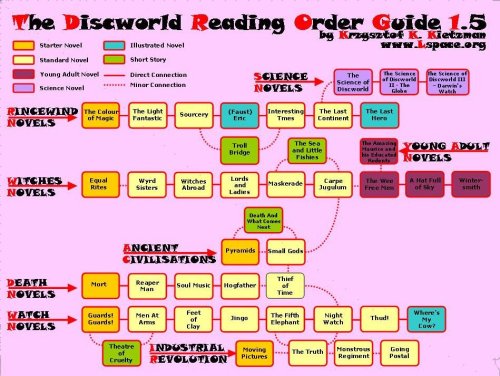
Terry Pratchett's Making Money is currently, well, making money, charting #4 on this week's NYTimes Best Seller List. The 33rd(!) book in Pratchett's Discworld series, new readers may feel a bit daunted. Fear not. Krzysztof Kietzman of Lspace.org has created the Discworld Reading Order Guide, which puts the main storylines of the Discworld books in their chronological sequence, with dotted lines showing how each storyline intersects with the rest. (Via: BoingBoing.net)

Malcolm Berko, the financial guru over at the Oklahoman.com warns his readers to stay away from investing in Barnes & Noble (and bookstores in general), saying, "Barnes & Noble is a very poor choice. You don't want BKS in your portfolio because future revenue gains will be miserly because of competition from video games, the Internet, TV and a declining literacy rate. Many Americans between ages 10 and 40 are infected with a genetic intellectual deficit. (We are observing a phenomena called 'the dumbing down of America” and what Dan Rather calls "the dumbing down of the news.')"
While it's hard to argue with the 'dumbing down' comments, I'd urge future/current bookstore owners/investors to ignore the rest of Berko's dreary portents, instead following the sage advice of a different Malcolm -- Malcolm X: By any means necessary.

NYTimes Best Sellers: Fiction
(now with excerpts)

To read the first chapters (or, in the case of stingier authors and/or publishers, brief excerpts), simply click the titles.

1. You've Been Warned by James Patterson and Howard Roughan

2. A Thousand Splendid Suns by Khaled Hosseini

3. Dead Heat by Dick Francis and Felix Francis

4. Making Money by Terry Pratchett

5. Pontoon by Garrison Keillor

6. The Wheel Of Darkness by Douglas Preston and Lincoln Child

7. Jonathan's Story by Julia London with Alina Adams

8. Wednesday Letters by Jason F. Wright

9. Bones To Ashes by Kathy Reichs

10. The Bone Garden by Tess Gerritsen

Friday, September 28, 2007

Book News, In Brief

Via Chron.com: "Author Douglas Brinkley says he's giving back the $100,000 advance he received from Penguin, for failing to promptly deliver a biography on writer Jack Kerouac. Penguin had sued Brinkley because he failed to finish the book in time to publish it on the 50th anniversary Kerouac's autobiographical novel On the Road."
Does anyone know if Brinkley tried to use the ol' 'Happy Belated Birthday Biography' line before returning the cash?

Via Xboxsolution.com:The newest installment in the Halo video game series was released this week, breaking all entertainment industry records (video games, music, movies and, yes, books) with a take of $170 million on the opening day alone. What does this have to do with bookstores, you ask? The next book in the spin-off/tie-in/cash-in series Halo: Contact Harvest hits stores on October 30th. This is the perfect book to push on lazy grandparents whose only knowledge of their kin is, 'Well, I know he/she likes video games.'

Via GuardianUK: "The mobile phone has changed the way Japanese teens read. Our media will be morphing soon, too. The latest of a new best-selling type of story, the keitai shosetsu, literally 'portable (phone) novel,' is read not on a page but on your phone screen. Of Japan's top 10 bestselling fiction works in the first half of this year, five began life as keitai shosetsu. Moved from pixel to page, their average sale is 400,000."

Thursday, September 27, 2007

Book Review: Songs In The Key Of My Life
by Ferentz Lafargue

Much like Nick Hornby's Songbook, Songs In The Key Of My Life is a song by song, chapter by chapter examination of various pop songs and their effects upon the author. But unlike Hornby's book, Songs In The Key Of My Life is intended as a memoir, rather than just a collection of personality-driven record reviews.

The book's format is established in the introduction: Lafargue details the recurring presence of Stevie Wonder's 1976 record, Songs In The Key Of Life, during his relationship with his one-time fiancee/current ex, and examines the way in which certain songs gained and lost significance depending on the state of their union. From there, the book jumps back and forth through time, chronicling the personal tragedies and comic moments that served as hallmarks in Lafargue's life, as well as a few of the highs and los in the last twenty years of pop music. Chapter two, for example, is a funny story about how a nine year old Lafargue used his mom's love of Billy Ocean to woo, and then lose, and then slightly re-woo the affections and attentions of a female classmate. Chapter three is an interesting look at how a "big, black Haitian kid who idolized hairy white boys" suddenly found himself feeling like less of an outsider due to the release of RUN DMC and Aerosmith's Walk This Way video.

An excerpt:
"Dancing to Walk This Way I felt less like a chubby Haitian kid rambling across his parents' room, and more like a man exuding the same swagger shown by the men performing on the TV screen. These perceived changes were affirmed that Monday in school. Everyone was talking about the Walk This Way video; and not only was everyone talking about it, but they were talking about it to me. They presumed that since I liked heavy metal I knew everything about each and every rock band. I remember being peppered with questions about Aerosmith: 'Who are they?' 'Do they like black people?' 'Do they have any other songs like this?'"

And on it goes, detailing Lafargue's thoughts on politics (via 2 Live Crew's Me So Horny, Destiny's Child's Bills, Bills, Bills and Bruce Springsteen's Born In The USA), spirituality (Kanye West's Jesus Walks), the loss of a loved one (Bone Thugs' Tha Crossroads) and the loss of innocence (Micheal Jackson's Thriller).

Songs In The Key Of My Life is a quick read. I read the whole thing in one afternoon -- while at work. This is largely due to the author's conversational and unpretentious style of writing. Lafargue's prose possesses the same pared down, easy-flowing quality that many of his favorite songwriters employ.

Click here to visit the author's website.

Wednesday, September 26, 2007

Book News, In Brief

Still golden, forty years on: The New York Times reassess S.E. Hinton's The Outsiders. Charges of plagiarism are addressed and dismissed -- not because they're unfounded, but because the final novel turned out so unmistakably original.

The New Yorker magazine has hired Pulitzer Prize-winning Irish poet Paul Muldoon as their new poetry editor. The GuardianUK finds this to be a refreshing, albeit ironic selection. "In 1990, Muldoon published a mischievous poem called Capercaillies, in which the first letters of each line spelt out, in acrostic, Is This a New Yorker Poem Or What? (The New Yorker maintains that it rejected the poem.)"

Borders has already drastically downsized their stock of cds and dvds, and it appears that ink & paper books are next. From ReadersRead: "Borders has renewed its agreement with Sony regarding the sale and promotion of the Sony Ebook reader. Under the new deal, Borders will continue to sell the Sony Readers, but will expand the number of stores where it is sold to 500 nationwide." Devoted Borders 'customers' are apparently okay with this, as it doesn't in any way threaten their freeloading, layabout habits. My advice to the company, though: don't f**k with your scone selection!

Tim Lucas' definitive Mario Bava biography, All The Colors Of The Dark, has finally been released. It's $260 (US), but that's why I asked for it for my birthday...two years ago. Delighted recipients have been posting pictures of themselves with their new, prized possession on the blog that Lucas set up specifically for the book. To the left is my personal favorite.

Tuesday, September 25, 2007

News Bits, In Brief
(saving your souls, one News Bit at a time)


Via AP: Norman Mailer will release On God: An Uncommon Conversation on Oct. 16. The book is to be "a series of 'Platonic dialogues' between the author and literary executor Michael Lennon." Judging from that picture, a conversation with God is soon to follow.

Via AP: "A rare first edition of the Book of Mormon found in a home near Palmyra, the birthplace of the Mormon religion, fetched $105,600 at auction Wednesday. Mormons consider the Book of Mormon to be scripture on par with the Bible." This reminds me of the tale of Mark Hofmann, a lapsed Mormon and professional forger who took the Mormon church for thousands of dollars in the 1980s. He sold the church fake letters supposedly written by the church's founders, letters that could have proved damaging to the reputation of the organization. At one point, Hofmann also sold the church a couple of faked pages of sacred Mormon scripture.

Via AP: "Codex Gigas, also known as The Devil's Bible — a medieval manuscript said to have been written 800 years ago with the devil's help — has returned to Prague after an absence of 359 years. The priceless piece, considered the biggest medieval book, was taken from the Prague Castle by Swedish troops at the end of the Thirty Years' War in 1648. It is in Prague on loan from Sweden's Royal Library in Stockholm. According to myth, a Benedictine monk promised to write the book overnight to atone for his sins. When he realized the task was impossible, he asked the devil for help. The page with the illustration of the devil is the one visitors see. The manuscript was likely written by one monk from the Benedictine monastery in Podlazice located some 65 miles east of Prague sometime at the beginning of the 13th century, said Zdenek Uhlir, a specialist on medieval manuscripts at the National Library. It contains 'a sum of the Benedictine order's knowledge' of the time, including the Old and New Testament, 'The War of the Jews' by the first-century historian Josephus Flavius, a list of saints, or a guideline how to determine the date of Easter, Uhlir said. 'I would estimate it took him between 10 and 12 years to write,' he said about the piece, which weighs 165 pounds. Originally, it had 640 pages, of which 624 survived in relatively good condition, he said."

Monday, September 24, 2007

Book Du Jour: The Shock Doctrine by Naomi Klein

From the publisher's website:
This is a book about shock, and the way it's applied to countries and people. It is the unofficial story of how the 'free market' came to dominate the world from Chile to Russia, China to Iraq, South Africa to Britain.

It is a story radically different from the one usually told. Based on breakthrough historical research and four years of on-the-ground reporting, Naomi Klein explodes the myth that 'free markets' lead to 'free people'. She reveals that our world is increasingly in thrall to a little understood yet hugely influential ideology: the shock doctrine. This is a doctrine that sees moments of collective crisis as a 'window of opportunity'. With societies too terrified or disoriented to protect their own interests, the free market advances, using the trademark tactic of rapid-fire economic shock therapy. Often, a refusal to comply results in distinctly more corporeal shocks: the shock of the Taser gun, or the electric cattle prod. Our history is littered with events that have provided opportunities for the shock doctrine. From the 1970s dictatorships of South America, through the Falklands War, Tiananmen Square and the collapse of the Soviet Union, Naomi Klein reinterprets our past to trace the rise of disaster capitalism, a program of social and economic engineering advanced through shock. Playing out today around the world in Israel, Iraq, New Orleans and South-East Asia, The Shock Doctrine reveals the true beliefs that lie behind global policy and in doing so reframes our history and our present.

To hear a podcast interview with the author, click here.

Don't trust self-promotion? Here are a handful of reviews from GuardianUK, NYTimes, Zmag.org, BlogCritics, Third Estate Sunday Review


And lastly, a brief commercial (artfully disguised as a documentary/sound bite pastiche) for the book by Klein and 'Children of Men' director Alfonso Cuarón:

NYTimes Bestsellers: Fiction
(now with excerpts!)

To read the first chapters (or, in the case of stingier authors and/or publishers, brief excerpts), simply click the titles.

1. You've Been Warned by James Patterson and Howard Roughan

2. A Thousand Splendid Suns by Khaled Hosseini

3. Pontoon by Garrison Keillor

4. The Wheel of Darkness by Douglas Preston and Lincoln Child

3. Bones To Ashes by Kathy Reichs

4. Dark Possession by Christine Feehan

5. Bones To Ashes by Kathy Reichs

6. Wednesday Letters by Jason F. Wright

7. Garden Spells by Sarah Addison Allen

8. The Quickie by James Patterson and Michael Ledwidge

9. Dark Possession by Christine Feehan

10. The Elves of Cintra by Terry Brooks

Friday, September 21, 2007

News Bits, In Brief

Via Bookforum, by way of BoingBoing: Revealed at last: Jack Kerouac's proposed design for the front cover of the paperback edition of On the Road. If it only took Kerouac three months to write the entire book, it couldn't have taken him more than three minutes to draw this.

Via WeberBooks.com: More competition! "Goodwill is diverting many of its best books to new book-only stores, where they'll be sold for about $3 to $8 apiece." If Goodwill was smart, they'd create an online store and sell them there. Everyone knows that that's where all of the book money is these days.

The New York Times examines the various methods publishers use to successfully roll out their newest books, and how today's news-in-an-instant internet culture is forcing a drastic restructuring of this.

Via Newsarama: DC Comics has announced the lineup for their newest condescending approach to kids' comic books, Johnny DC. Some the titles that will be appearing in 2008 are Billy Batson and the Magic of Shazam, Tiny Titans, and Super Friends. What the good-intentioned folks over at DC seem to be forgetting is that kids don't want to know that they're reading 'kids' comics.' They want to think that they're reading something aimed at teens. Hell, if DC would just make their regular line of comic books a little more accessible to the new reader -- child or adult -- I'm sure they'd find these silly, ill-fated experiments unnecessary. (Doesn't anyone else remember the quick crash and burn of Marvel's 'manga inspired' Tsunami line?)

Wednesday, September 19, 2007

Ode to Independents
by Cristin Cali

I was driving down Rt. 149 the other afternoon and noticed that there was a pizza delivery car in front of me. I was amused by the colorful decals plastered all over the car, advertising an adorable, eager-to-please restaurant. For some reason, I started to draw parallels between the pizza business and the independent book-selling industry.

We’re all aware that the big pizza chains are Dominos, Papa Gino’s and Pizza Hut. As a little kid in the late 80s, I remember those three restaurants being the King, Queen and Prince of the pizza world. On a cold or miserable rainy night at the end of a long day my parents would sometimes resort to take out or the occasional delivery. When we ordered from the chains, each pizza would taste exactly the same every time, without the slightest variation.While there may be something comforting about the predictability of a franchise, there’s nothing particularly memorable or special about it either. On the other hand, while growing up in West Barnstable, I would frequently make a pilgrimage (one exclusive to children under the age of fifteen) to the Old Village Store. Whenever I would round the corner (after stopping at the library, of course) I would eagerly anticipate the sight of the maroon building and the dusty scent of its old wooden floor.

Next to the Village Store was the most unassuming pizza parlor, appropriately named Old Village Restaurant and Pizza. I remember it being extremely small, with an Old World atmosphere. In the summer, a batch of strong, tall sunflowers would flourish in front of the quaint little porch where people would sit and devour their massive, piping hot slices.

I attribute my fond memories of Old Village Pizza to the gruff, wrinkled woman who barked orders behind the counter, the romantic ethnicity of the place, and its perfectly sparse decorations. That one restaurant evokes more charm and memories than all of my experiences with the large franchises combined.

So, in thinking about all of this while I was stuck behind the delivery car, I concluded that independent bookstores and humble, locally owned pizza places are quite similar.

I’ve been in the large chain bookstores and they are all the same, no matter where I go. Such homogenized businesses send a shiver down my spine, because they lack warmth and feeling. However, there are still (thank goodness!) plenty of unusual, charming, independent bookstores out there for adventurous book lovers to discover and celebrate.

It takes more time and effort to go to the unique places where we’ll be most likely to have a memorable, truly enjoyable experience. If you are able to spend time finding such precious gems, you will be rewarded with the creativity, quirks, passion and most importantly, the humanity that’s exclusive to independent shops around the world.

Author Du Jour: Jim Woodring

From Wikipedia.com:
Jim Woodring (born October 11, 1952) is a comic book author and artist. He was born in Los Angeles, USA, and lives in Seattle. As a child he suffered from hallucinations of floating, gibbering faces over his bed (among other visions), and his work still has a very surreal and often nightmarish quality. Woodring once told The Comics Journal that under the right circumstances he is still capable of "hallucinating like mad." The desire to draw something that "wasn't there" was always of "paramount importance" to Woodring.

A self-taught artist, Woodring dropped out of college when he hallucinated a cartoon-like frog in the middle of an art history course. (Frogs feature prominently in Woodring's comics, and their symbolism seems to change from story to story. Often they are spiritually-minded but rather pompous creatures, but at other times they are more sinister and alien, at at still other times they are "average joes" struggling to protect their homes or their families from predators.) He spent a few years working as a garbageman and developed a serious drinking problem; he eventually quit drinking because he felt it was interfering with his growth as an artist. He then landed a job with the animation studio Ruby-Spears in the 1970s. He worked designing characters and doing layouts for cartoon shows about Mr. T and Rubik's Cube, and he has often said that these were the worst cartoons ever produced. During this time he formed friendships with and was somewhat mentored by celebrated comic book artists Gil Kane and Jack Kirby, who were both disgruntled with the comics business and were working in animation at the time.

In 1980, he began self-publishing Jim, an anthology of comics, dream art, and free-form writing which he described as an "autojournal". Jim was published as a regular series by Fantagraphics Books starting in 1986, to critical acclaim if less than spectacular sales, and Woodring became a full-time cartoonist. Frank, a wordless surrealist series which began as an occasional feature within Jim, became his best-known work.

Other Woodring characters include Pulque - a perpetually drunken, man-sized, Spanish-speaking frog-creature who inexplicably hangs around with a group of American, suburban children despite the fact that they cannot understand each other and are drawn in markedly different styles - and Big Red, a large street cat who hunts and kills with an appropriately cat-like gusto made chilling by the fact that we can understand his dialogues with his prey ("I'll kill you," shrieks a terrified possum, "I killed the old owl!" "That's nice," is Red's amused response, as he moves in for the kill.)

Woodring created a short-lived comics series for children, Tantalizing Stories, with Mark Martin. He has also worked as a freelance illustrator and comics writer, writing comics based on Aliens and Star Wars for Dark Horse Comics and adapting the film Freaks with F. Solano Lopez. Additionally, Woodring illustrated Microsoft's Comic Chat program, an IRC client which is notably employed in the creation of the daily Internet comic Jerkcity. In recent years Woodring has also become a popular toy designer, with his strange creations sold in vending machines in Japan and available at hip comics shops in America. In a 2002 interview with The Comics Journal, Woodring said that he was gradually leaving comics behind because they simply weren't lucrative enough, and he was increasingly concentrating on individual paintings. Still, Woodring produced a new Frank book in 2005 (The Lute String) and is working on another.
(End of Wikipedia entry.)

For a more personal look at the man, check out Woodring's own blog, here, or read the Comics Journal interview here.

Too shy for such an intimate encounter? Then by all means, go the formal route and visit The Official Jim Woodring Website, which also happens to house The Official Jim Woodring Website's Official Art Gallery.

And lastly, for the lazy, Visions Of Frank, a series of short films by some of Japan's hippest animators, all based on the Frank comics by Woodring.